Information magazine of the Department of Industrial Engineering
Università di Trento
A brake pad is far from being a simple material. A single formulation contains dozens of different ingredients, each with a specific function (as illustrated in the table below).
Among these, the binder plays a key role: it is the “glue” that holds all the other components together and determines the mechanical integrity of the material. Its influence is crucial not only for braking performance, but also for the amount of particulate matter emitted during use, an aspect that has become increasingly important in efforts to reduce the environmental impact of vehicles.
For many years, the reference binder has been phenolic resin, valued for its low cost and good thermal properties. However, it also has some drawbacks: it has a relatively short shelf life, is sensitive to moisture, and may generate unwanted by-products during processing.
In this context, benzoxazine resins represent a new generation of binders capable of overcoming many of these limitations. Thanks to a different polymerization mechanism, they offer virtually unlimited shelf life, complete insensitivity to moisture, and do not produce harmful by-products. Their thermal resistance is comparable, and potentially superior, to that of traditional phenolic resins. Moreover, the modular structure of the starting monomers makes it possible to tailor the final properties to specific application requirements.
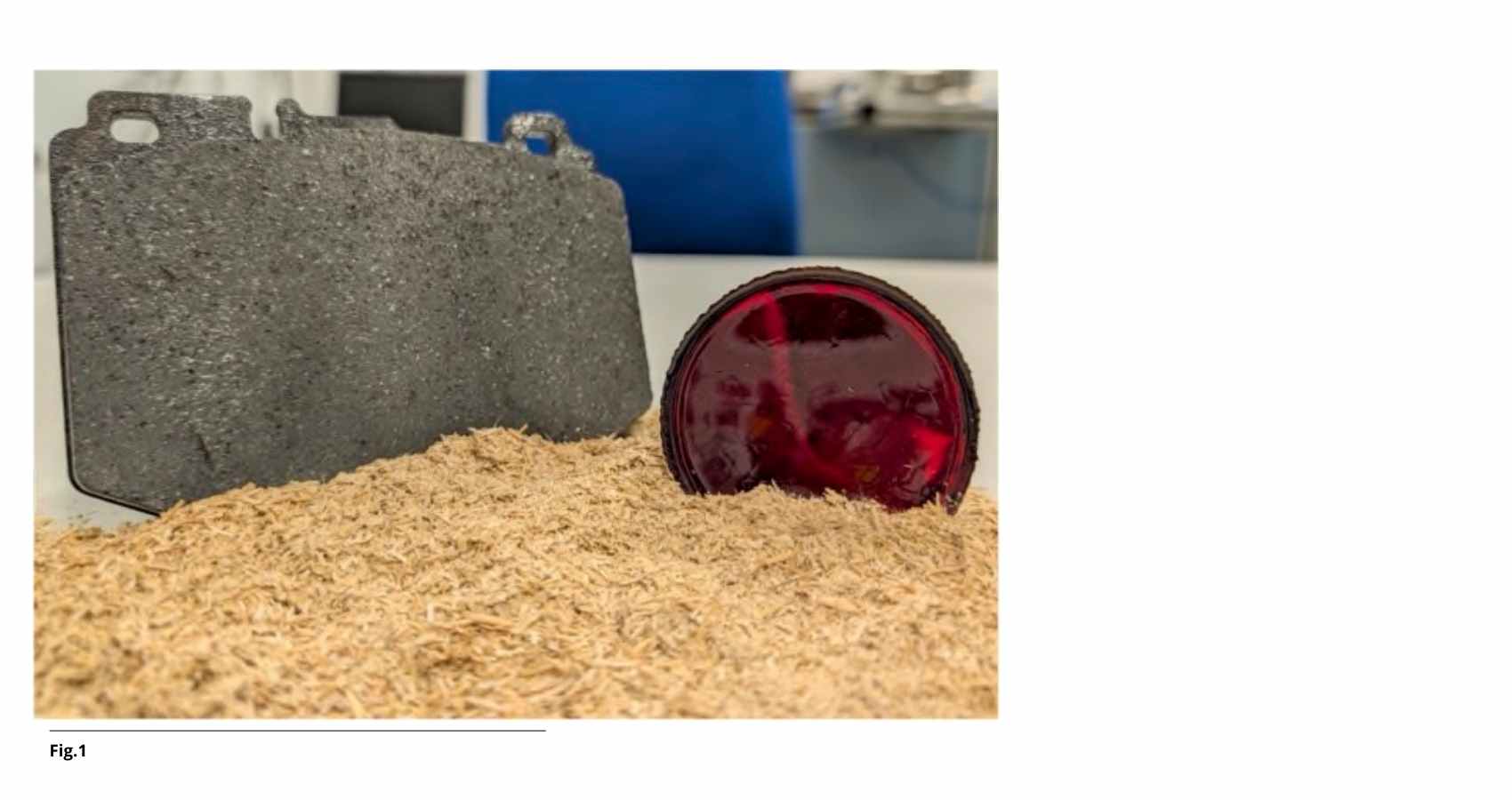
The research carried out at the DII investigated the use of two different benzoxazine resins as binders for friction materials. In addition, a new bio-based ingredient was introduced: rice husk. This choice is clearly oriented toward environmental sustainability, a topic of growing importance in the development of braking systems.
After a preliminary characterization of the components, they were incorporated into a commercial formulation and tested using several tribological setups, including a Pin-on-Disc tribometer and a reduced-scale dynamometer capable of simulating real braking processes.
The results show that brake pads made with benzoxazine resins provide braking performance equivalent to those based on conventional phenolic resin. In addition, they exhibit improved wear resistance, resulting in lower particulate emissions and longer friction material lifetime, an outcome of particular relevance from an environmental perspective.
As for rice husk, it does not significantly affect braking performance under normal operating conditions. As expected for lignocellulosic materials, some limitations emerge at higher temperatures, typical of very intense braking events. This confirms that it is not an optimal solution for high-performance applications, such as racing.
It is important to note that these benefits were achieved using relatively simple formulations, leaving ample room for further improvements through targeted monomer design.
Future research will focus on additional types of benzoxazine resins, aiming to further optimize braking performance, wear resistance, and environmental impact.
Rice husk will also be investigated further, both in different formulations and in combination with various brake disc materials. Preliminary results suggest its possible use as a filler, while its potential role as a functional additive, such as for improving braking comfort, is also being explored.
The ultimate goal is to identify more sustainable alternatives to current friction materials by exploring new natural resources. In this direction, ongoing studies are also examining the use of seashells as a potential component for braking systems.
The research was conducted in collaboration with Brembo N.V.
Fig.1: Brake pad featuring two innovative ingredients: rice husk and a new benzoxazine resin.