Information magazine of the Department of Industrial Engineering
Università di Trento
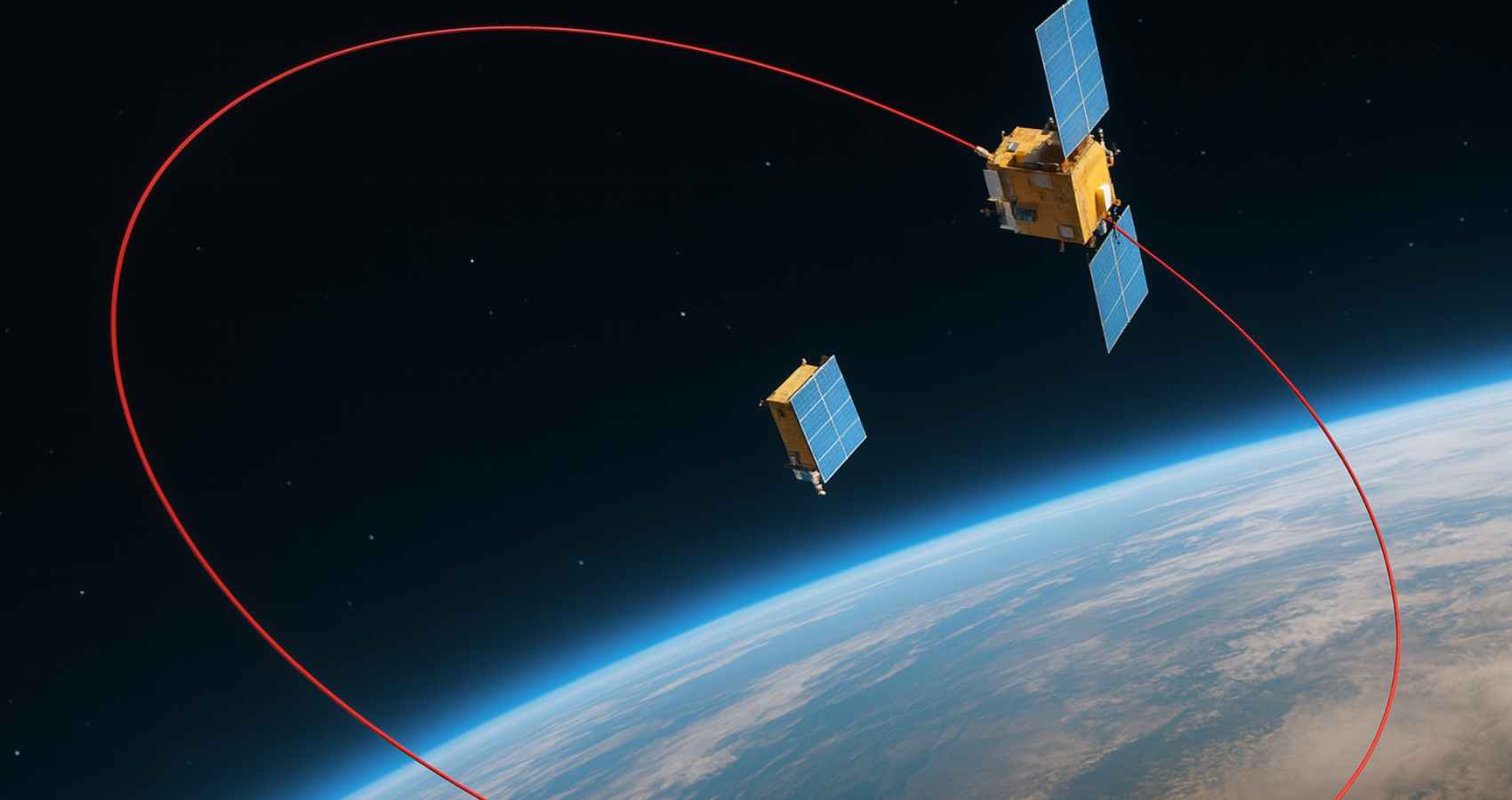
Imagine two satellites orbiting the Earth along elliptical trajectories. One (the leader) follows its natural path; the other (the follower) must approach it with millimeter-level precision to inspect, refuel, or repair it. This is the space rendezvous problem: an orbital ballet in which any miscalculation can jeopardize a mission or endanger both vehicles.
The challenge arises from the fact that in space it is impossible to “brake” or “steer” continuously as on roads or in the air. Maneuvers are performed through short thruster firings, known as propulsion impulses, which instantaneously change the satellite’s velocity. Each impulse consumes valuable fuel, so control must be not only precise but also fuel-efficient.
Over the years, several mathematical models have described the relative motion between two satellites, but for elliptical orbits (the most common case) the equations become non-stationary, meaning they change at every point along the orbit. This makes it difficult to design simple and reliable control laws.
The contribution of this research, carried out in collaboration between the Department of Industrial Engineering, LAAS-CNRS (Toulouse, France), and the University of Seville (Spain), stems from an elegant idea: by choosing the right coordinate system, even a complex problem such as rendezvous in elliptical orbits can become more manageable.
The ongoing investigations, relevant to the “Space It Up!” project funded by the Italian Space Agency (ASI), focus on developing solutions that can be implemented under propulsion constraints defined by minimum and maximum thrust levels, guaranteed for each impulse autonomously triggered by the control law.
Using Floquet–Lyapunov theory, the researchers propose a periodic coordinate transformation that “stationarizes” the relative motion between the two satellites. In practice, this transformation allows the dynamic system to be rewritten in a constant-coefficient form, which is much easier to analyze and control.
In these new coordinates, the “free” motion of the satellites (i.e., when no impulses are applied) becomes a Linear Time-Invariant (LTI) system. It is as if a disordered orchestra, with each instrument playing at a different tempo, suddenly became perfectly synchronized thanks to a change in the score.
This simplified representation makes it possible to describe all feasible periodic trajectories using a small number of constant parameters, paving the way for more interpretable control strategies with rigorous mathematical guarantees.
Once the new formulation is obtained, the second part of the study addresses the core question: how to choose propulsion impulses to guide the follower satellite into the desired region near the leader. The researchers model the system as a hybrid dynamical system, in which two types of evolution coexist:
This formalism, well known in hybrid dynamical systems theory, allows not only accurate simulation of maneuvers but also rigorous mathematical proofs of stability and convergence induced by the proposed control laws.
The paper presents three different impulsive control laws, each offering a different trade-off between computational complexity and fuel consumption:
This range of approaches makes the methodology adaptable to missions with different constraints, from small CubeSats to more complex vehicles intended for on-orbit servicing.
Numerical results show that the proposed control laws successfully guide the satellite toward its target orbit even when nonlinearities and perturbations not included in the design model are taken into account. In other words, the theory remains effective in highly realistic representations of the physical world. This approach represents a step forward toward the future of autonomous space missions, in which satellites will need to cooperate without direct human intervention, for example, to refuel or repair other vehicles, remove space debris, or form coordinated satellite constellations. The use of the hybrid formalism also guarantees fault tolerance and safety properties, which are crucial for close-proximity operations where every centimeter matters.
In summary, this research shows how advanced mathematical tools such as Floquet–Lyapunov theory and hybrid dynamical systems can be translated into practical strategies for satellite navigation and control, making space exploration more autonomous, efficient, and safe.