Information magazine of the Department of Industrial Engineering
Università di Trento
Due to global warming and the increasing frequency of heatwaves, cooling systems have become essential for billions of people. Today, around 2 billion air-conditioning units are in operation worldwide, and this number is estimated to reach 5.6 billion by 2050. The systems currently in widespread use, based on vapor compression, require significant amounts of electricity and rely on refrigerants with a high environmental impact. In the event of improper installation, maintenance, or disposal, these fluids may also be accidentally released into the environment. Making cooling systems more efficient and sustainable is therefore one of the major technological challenges of the coming years.
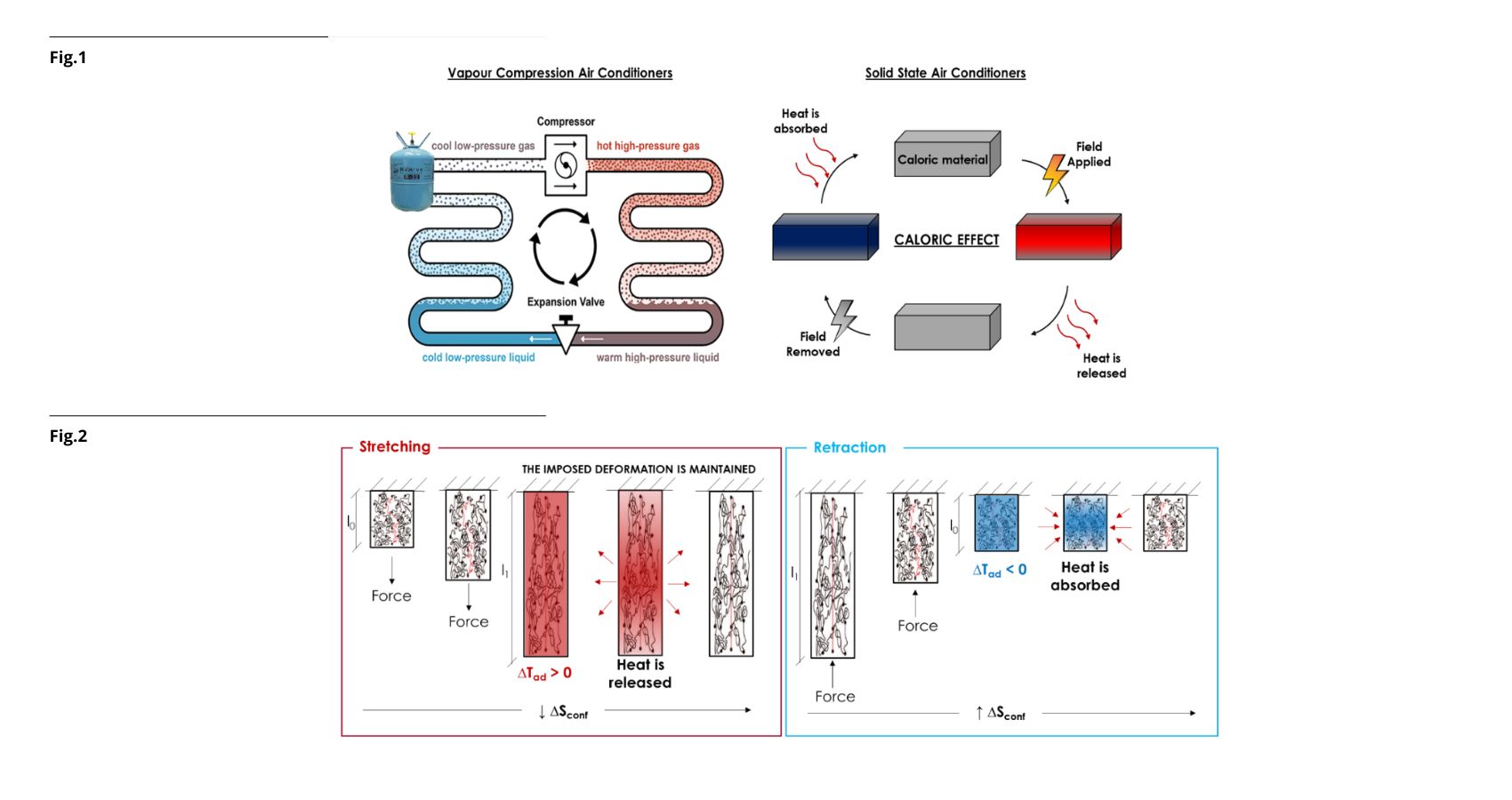
In this context, solid-state cooling is emerging as a potential alternative to conventional systems. The main difference concerns the type of refrigerant used: while traditional systems rely on a fluid, solid-state systems employ materials capable of reversibly changing their temperature in response to the application and subsequent removal of an external stimulus. This behavior underlies the so-called caloric effects. Depending on the stimulus applied, these include the elastocaloric effect, induced by mechanical stress; the magnetocaloric effect, associated with a magnetic field; the electrocaloric effect, generated by an electric field; and the barocaloric effect, produced by hydrostatic pressure. Among these technologies, elastocaloric cooling is considered one of the most promising alternatives to conventional systems.
Figure 1. Schematic comparison between the traditional vapor-compression refrigeration cycle (left) and solid-state cooling based on caloric effects (right).
In elastomers, the elastocaloric effect is mainly related to thermoelasticity. When an elastomer is rapidly stretched, its macromolecules, initially arranged in a disordered, high-entropy configuration, tend to align in the direction of deformation. This reorganization results in a decrease in entropy and an increase in the material’s temperature. When the stress is removed, the macromolecules tend to return toward their initial, more disordered configuration. The material cools down and absorbs heat from the surroundings. The cyclic application and removal of a simple mechanical load can therefore be used to create a refrigeration cycle.
Figure 2. Schematic representation of the elastocaloric effect in elastomers (ΔS_conf = change in configurational entropy).
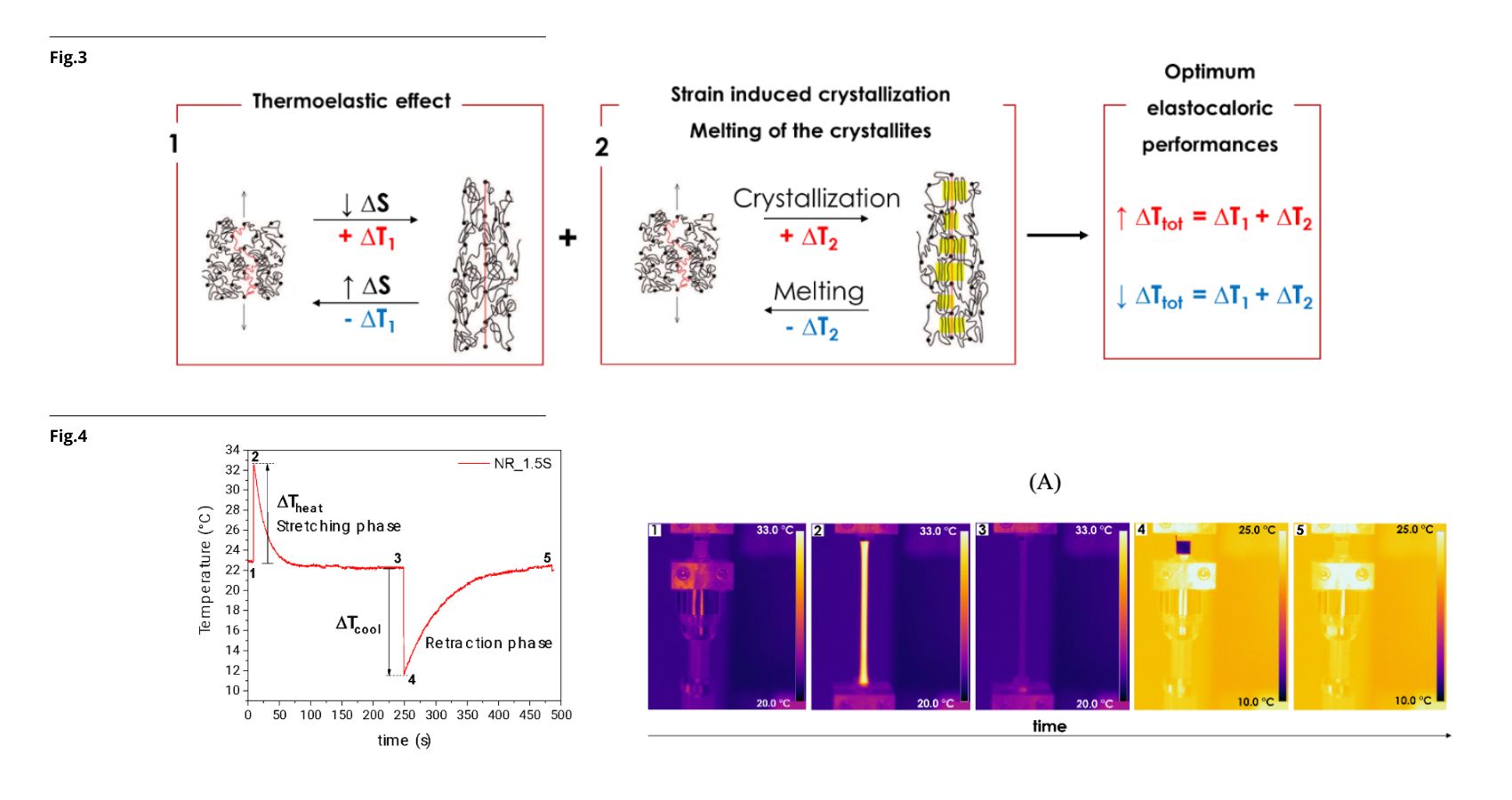
Among elastocaloric materials, natural rubber is one of the most interesting candidates. It is a renewable, inexpensive, and non-toxic resource, characterized by high fatigue resistance and remarkable elastocaloric properties. In this material, the thermoelastic response is accompanied by the phenomenon of strain-induced crystallization. During stretching, the alignment of the macromolecules promotes the formation of temporary crystalline structures, which contribute significantly to the temperature change of the rubber.
Figure 3. Schematic representation of the two main contributions to the elastocaloric effect of natural rubber: the thermoelastic effect and strain-induced crystallization, which together contribute to the temperature change of the material.
Despite these favorable characteristics, solid-state cooling technologies still show lower performance than conventional vapor-compression systems. Further development is therefore needed before they can become truly competitive. Even in the case of natural rubber, not all the parameters affecting its elastocaloric behavior are yet fully understood. Identifying them is essential to optimize the material’s performance and develop more efficient cooling systems.
This context provided the basis for doctoral research carried out at the Department of Industrial Engineering of the University of Trento. The research aimed to understand how the internal structure and formulation of rubber can influence the elastocaloric properties of natural-rubber-based materials. The work focused on two main research directions: studying the influence of crosslink density and analyzing the effects produced by the addition of nanofillers.
The first part of the research involved the preparation and characterization of different natural rubber formulations with varying crosslink densities. This parameter determines the degree of freedom with which polymer chains can orient themselves when the material is deformed, directly influencing its response to mechanical loading. The materials were characterized in terms of their structural, thermal, and mechanical properties and subsequently analyzed for their elastocaloric performance. The results showed that crosslink density plays a fundamental role in determining the cooling performance of natural rubber.
In particular, a lower crosslink density improved cooling capacity by enhancing both the thermoelastic contribution and strain-induced crystallization. Among the formulations investigated, the one with the lowest crosslink density produced the most promising results, reaching a temperature change of approximately 12 °C during cooling. The internal structure of rubber therefore emerged as a key factor in the development of more efficient elastocaloric materials.
Figure 4. Temperature change of one of the specimens during stretching and release, measured using a high-speed tensile testing machine, with a maximum applied strain of 500%. (A) Temperature as a function of time. (B) Corresponding surface-temperature images acquired using an infrared thermal camera.
Building on the formulation that had shown the most promising performance, the second part of the research focused on the addition of clay-based nanofillers. Two types of nanoclay were investigated, one natural and one organomodified, and incorporated into the rubber at different concentrations. The objective was to determine whether these particles could modify not only the mechanical properties of the material, but also its elastocaloric response. The results revealed significant differences between the two systems. The better dispersion of the organomodified nanoclay within the rubber matrix improved stiffness and mechanical strength and, most importantly, produced a significant increase in cooling performance compared with systems containing natural nanoclay.
Natural rubber samples containing organomodified clay achieved an increase of up to approximately 45% in the heat absorbed per refrigeration cycle compared with unfilled natural rubber. This improvement was attributed to the combination of several phenomena: increased strain-induced crystallization, a more homogeneous macromolecular structure, and possible strain-amplification effects promoted by the presence of organoclays.
Overall, the research demonstrated that elastocaloric performance depends not only on the conditions under which a material is deformed, but also, and above all, on its internal structure and formulation. The ability to control the crosslink density of rubber and modify its structure through the addition of nanofillers opens up new opportunities for designing more efficient elastocaloric materials. The results of this research therefore represent a step forward toward the development of solid-state cooling technologies capable of reducing the energy consumption and environmental impact of air-conditioning systems.