Information magazine of the Department of Industrial Engineering
Università di Trento
Additive manufacturing, commonly known as 3D printing, is often described as a technology capable of revolutionizing production processes. It enables the creation of complex geometries, product customization, and efficient operation even for small production batches. However, behind these potentials lies a less visible but fundamental challenge: making decisions in a complex and uncertain environment.
When a company adopts 3D printing, it is not simply choosing a machine. Rather, it faces a set of interconnected decisions in which different technologies — each with distinct characteristics, costs, and performance levels — must be selected, combined, and managed over time. In this sense, additive manufacturing is not only a technological issue, but above all a decision-making problem.
A first difficulty stems from the fact that these decisions are intrinsically multidimensional. Choosing and using a 3D printer involves balancing different criteria: cost, precision, speed, material compatibility, reliability, and so on. These aspects are often in conflict with one another: a higher-performing machine may be more expensive, while a cheaper solution may prove less versatile or less reliable. In this scenario, decisions based solely on intuition or experience risk being fragile, especially in a constantly evolving market.
To address this complexity, it is necessary to adopt a structured approach that makes the trade-offs between the different factors explicit. The idea is to interpret additive manufacturing through multi-criteria and multi-objective decision analysis tools, which make it possible to break down complex problems into their fundamental elements and systematically evaluate the available alternatives.
This means, on the one hand, organizing decisions in terms of clear and comparable criteria, reducing inconsistencies and subjectivity. On the other hand, it implies recognizing that decisions are not isolated: choosing a technology today shapes tomorrow’s production possibilities. For example, investing in a certain type of printer may support some applications while simultaneously creating constraints or bottlenecks for others.
From this emerges a broader perspective, in which decisions about which technologies to adopt and how to use them are considered jointly and over a time horizon. In this context, uncertainty plays a central role: demand may vary, production times are not perfectly predictable, and machine availability may be affected by maintenance or unforeseen events. Rather than ignoring these aspects, they can be explicitly integrated into the analysis by evaluating how different strategies perform across multiple future scenarios.
An important outcome of this approach is that there is no single “optimal” solution. Instead, there exists a set of possible strategies, each characterized by a different balance between competing objectives. For example, one strategy may minimize costs but fail to consistently satisfy demand; another may be more robust and reliable but require greater investments. The objective is therefore not to find a unique answer, but to provide a map of alternatives, highlighting the trade-offs associated with each of them.
This shift in perspective — from searching for the best solution to understanding trade-offs — is particularly relevant in modern production systems. It allows companies to make more informed decisions aligned with their priorities, which may concern economic efficiency, service level, or operational robustness.
Overall, the message that emerges is that, with the growing diffusion and complexity of 3D printing technologies, the real challenge is no longer only “what can we produce?”, but rather “how do we decide what to produce, with which technologies, and under what conditions?”. Addressing this challenge requires integrating engineering expertise with advanced decision-support tools capable of managing complexity and uncertainty.
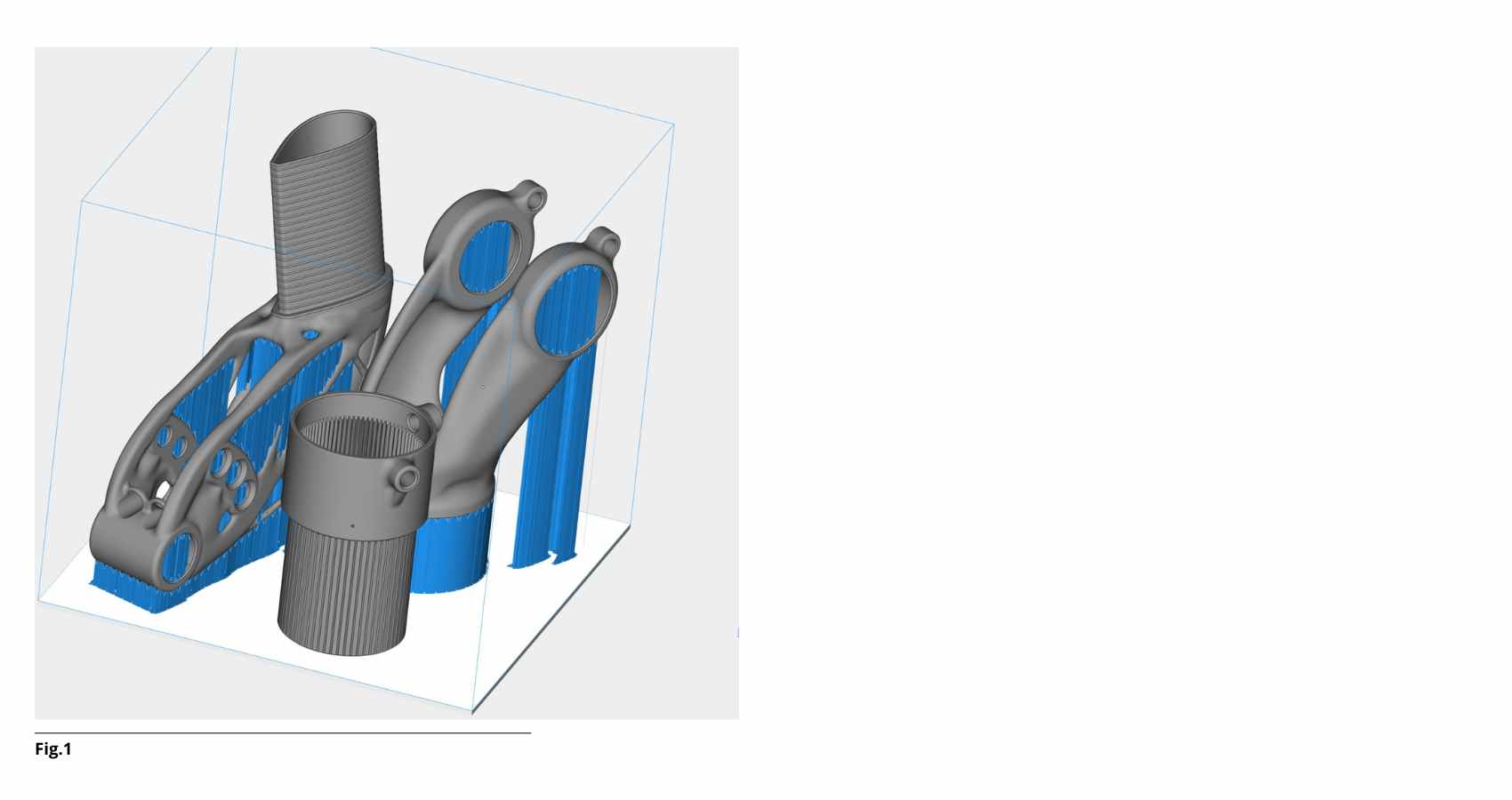
Figure: rendering of some components that can be printed using one of the printers considered.