Information magazine of the Department of Industrial Engineering
Università di Trento
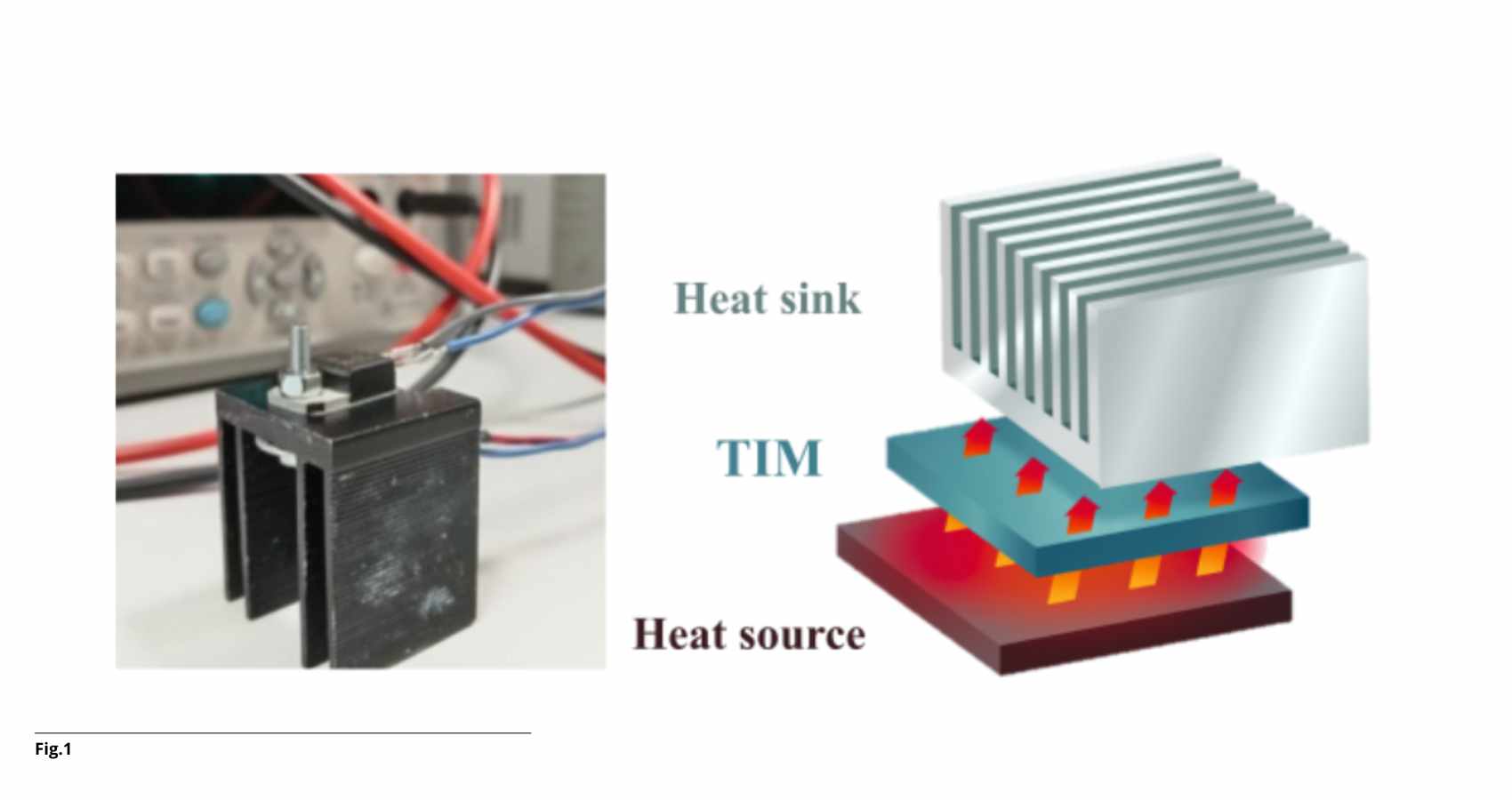
The increasing miniaturization and ever-higher power density of electronic components have made heat accumulation and inefficient thermal dissipation major challenges, as they negatively affect device reliability, operational stability, and service life. To improve heat transfer and eliminate air gaps between electronic components and heat sinks, polymer-based Thermal Interface Materials (TIMs) are widely used (Fig. 1). Besides exhibiting high thermal conductivity (TC) and electrical insulation, these materials must also provide thermal-mechanical stability and flexibility to conform to surface irregularities and withstand mechanical stresses during assembly and operation.
In polymers, heat is transferred mainly through the molecular vibrations of macromolecular chains (phonons), which carry thermal energy. The thermal conductivity of polymers is significantly lower than that of metals and ceramics and strongly depends on the characteristics of the macromolecular structure. Rigid chains, double bonds, and aromatic rings generally increase thermal conductivity because they promote stronger intermolecular interactions. Semicrystalline polymers exhibit higher thermal conductivity than amorphous polymers, where enhanced phonon scattering leads to poorer heat transport. Crosslinking processes improve thermal conductivity by creating covalent interactions that restrict chain mobility, thereby facilitating heat transfer. Weak intermolecular interactions, such as hydrogen bonding, π–π interactions, and van der Waals forces, also influence thermal conductivity. Therefore, the design of thermal interface materials should aim to achieve synergy between crosslinking and weak intermolecular interactions in order to promote efficient phonon transport.
To substantially increase thermal conductivity while maintaining electrical insulation for electronic applications, ceramic fillers such as alumina nanoparticles must be incorporated into the polymer matrix. The filler–matrix interface plays a critical role in determining the thermal conductivity of nanocomposites because poorly bonded interfaces generate thermal resistance and increase phonon scattering. Functionalizing nanoparticles with chemical groups compatible with the polymer matrix not only improves filler dispersion but also reduces interfacial thermal resistance. Optimizing filler–polymer interactions is therefore a key aspect in the development of advanced thermal management materials.
Ladder-like polysilsesquioxanes (LPSQs) are a class of hybrid organic–inorganic polymers synthesized via sol-gel hydrolysis-condensation reactions of trialkoxysilane precursors, RSi(OR)₃. They have the general formula (RSiO₁.₅)ₙ and consist of a double-stranded inorganic ladder backbone formed by Si–O–Si bonds, functionalized with organic side groups (-R) attached to the silicon atoms. This unique structure provides LPSQs with outstanding properties, including high thermal stability, excellent mechanical and chemical resistance, superior dielectric properties, compatibility with organic polymers, and the ability to form stable, uniform films.
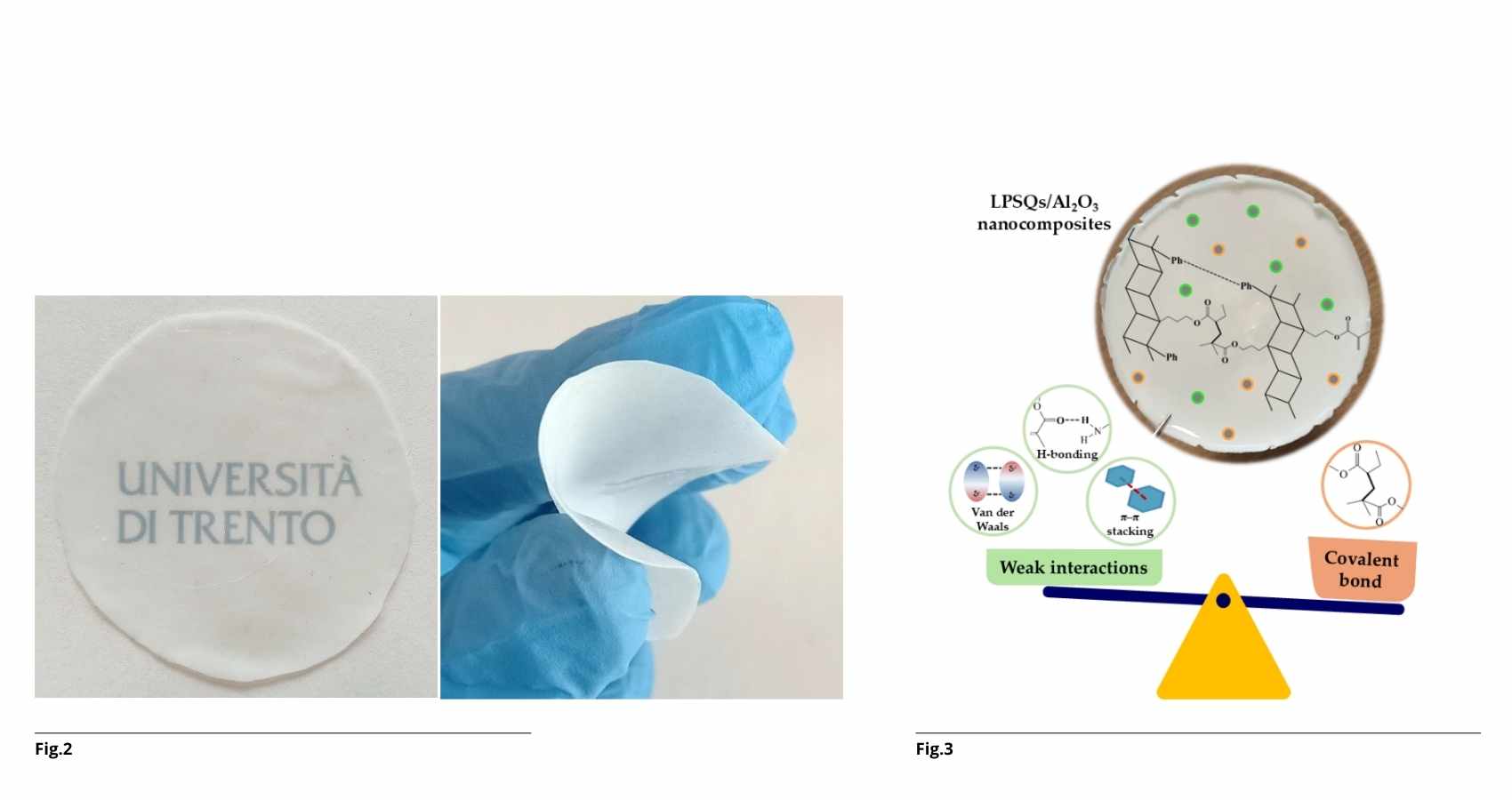
The potential of ladder polysilsesquioxanes as thermally conductive polymers for heat dissipation has recently been demonstrated by the Materials Chemistry Group. Owing to their low coefficients of thermal expansion, relatively high thermal conductivity, and excellent dimensional stability, LPSQs represent promising polymeric solutions for dissipating heat and reducing thermal stress in electronic devices. In this study, photocurable LPSQs were designed by introducing methacrylate groups together with phenyl groups in different proportions, allowing a systematic investigation of how thermal conductivity is affected by different chemical interactions. These inorganic polymers are excellent matrices for dispersing functionalized Al₂O₃ nanoparticles and can be blended with organic polymers such as polybutadiene to produce flexible nanocomposites (Fig. 2).
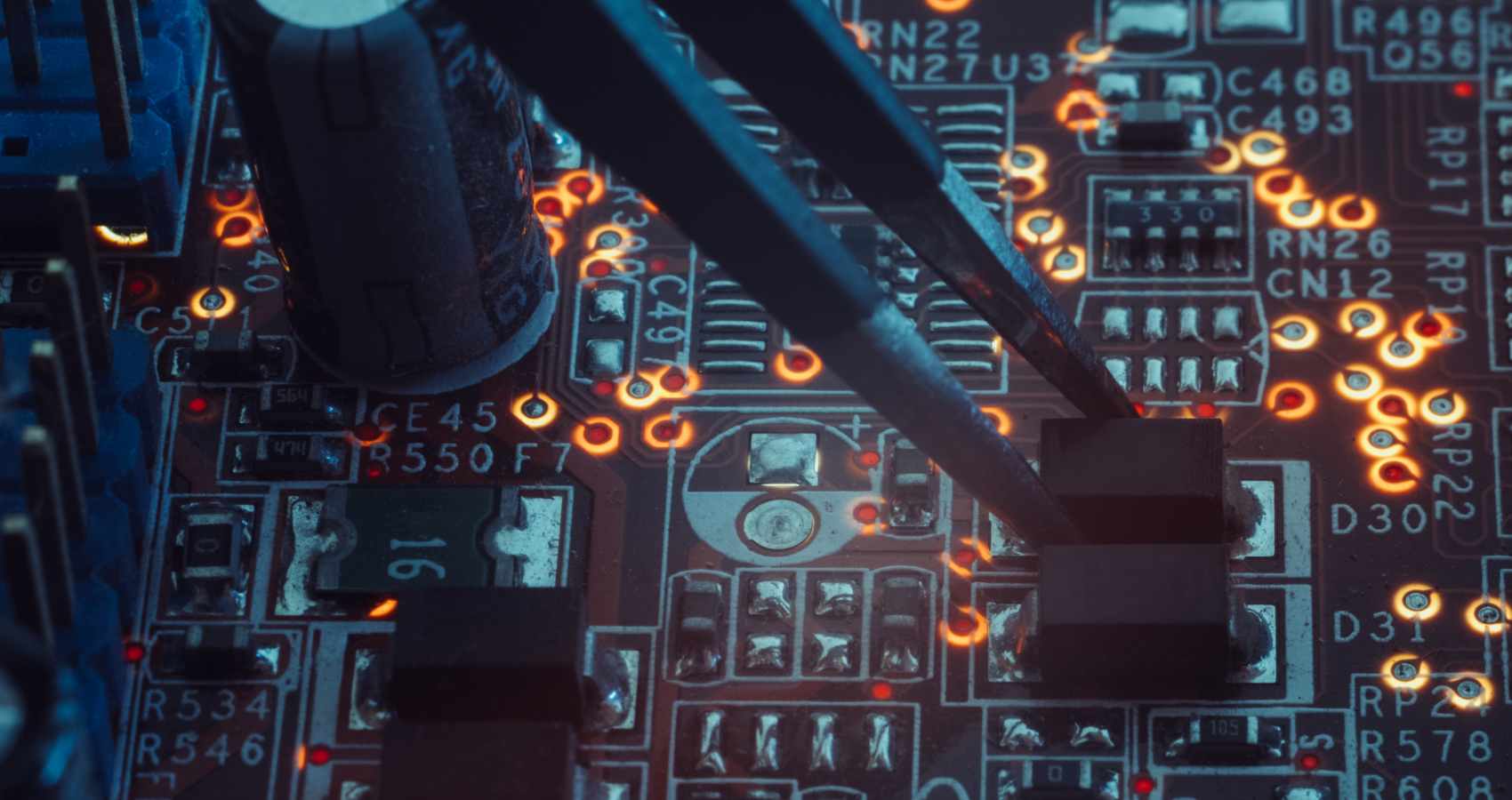
The study demonstrated that thermal conductivity depends on the conformations adopted by the ladder structures, the surface functionalization of the nanoparticles, and, most importantly, the balance between crosslinking density and non-covalent interactions both among macromolecules and between filler and matrix. Methacrylate groups provide reactive sites for photocrosslinking, which reduces chain mobility and consequently enhances heat transport while also improving mechanical strength, chemical resistance, adhesion, and scratch resistance. Phenyl groups promote π–π stacking interactions, increasing both packing density and the rigidity of the ladder polymer chains. The functionalization of alumina nanoparticles with methacrylate- and amino-functional trialkoxysilanes was specifically designed to modulate interfacial thermal resistance. Methacrylate groups on the nanoparticle surface form covalent interactions both between neighboring nanoparticles and with the corresponding methacrylate groups of the ladder polymers, thereby enhancing phonon transfer from the nanoparticles to the polymer matrix. Amino groups, on the other hand, interact with the LPSQ side chains through hydrogen bonds and van der Waals forces. Overall, the study clearly demonstrated that weak intermolecular interactions, particularly π–π stacking, compensate for the reduced contribution of crosslinking in mixed methacrylate/phenyl matrices at specific functional group ratios, while simultaneously enabling the fabrication of highly filled yet flexible nanocomposites (Fig. 3).
The results demonstrate that controlling both the chemistry of the polymer chains and the surface chemistry of the nanoparticles enables the optimal cooperation among different interfacial interactions (Fig. 3). A preliminary evaluation of a TIM based on a nanocomposite consisting of polybutadiene, an LPSQ with a methacrylate/phenyl ratio of 40/60, and only 4 vol% functionalized nano-alumina provided thermal performance comparable to that of commercial thermal interface membranes used in electronic devices. These findings confirm the significant potential for further optimizing LPSQ-based polymer nanocomposites for advanced thermal management applications.