Information magazine of the Department of Industrial Engineering
Università di Trento
This is a story that begins far away, in the materials science laboratories of Tohoku University in Sendai, Japan. In 1976, Professor Shigeyuki Yajima made a discovery that would profoundly change how advanced ceramic materials are conceived: he demonstrated that silicon carbide (SiC) ceramic fibers, with extremely high mechanical strength (3–4 GPa) and stability beyond 1600 °C, could be obtained from polymer fibers. The underlying principle was as simple as it was revolutionary: an organometallic polymer—polycarbosilane—was transformed into ceramic through heat treatment in an inert atmosphere. During pyrolysis, the material progressively lost hydrogen, converting into a silicon carbide ceramic fiber. Thus, the concept of Polymer-Derived Ceramics (PDCs) was born: a paradigm that complements traditional sintering processes with a completely new approach based on the controlled transformation of polymers into ceramic materials.
The impact of this innovation was immediate. SiC fibers enabled the development of ceramic matrix composites (CMCs) capable of operating under extreme conditions, finding applications in the aeronautical and aerospace sectors, where lightness, strength, and thermal stability are essential requirements. Over time, PDC research has expanded well beyond silicon carbide, including increasingly complex systems such as SiCN, SiOC, and multicomponent materials (Si–B–O–C, Si–Ti–O–C, Si–Al–O–C, among others). These materials offer tunable properties at the nanoscale, high chemical stability, and resistance to oxidation and creep at high temperatures. A common characteristic is their black color, linked to the presence of a nanoscale free carbon phase. However, this component also represents a design lever: its quantity and distribution significantly influence electrical, optical, and mechanical properties.
Within this context lies the work of the Glass and Ceramics Laboratory of the DII, which has developed a distinctive research line on silicon oxycarbides (SiOC) derived from polymer precursors. One of the most significant achievements concerns the fine control of material composition by acting directly on precursor chemistry. This made it possible to obtain SiOC free of residual carbon, overcoming the typical dark coloration. The result is remarkable: materials that retain the excellent thermo-mechanical properties of silicon oxycarbides, high stability, hardness, and viscosity, while also being optically transparent, with characteristics similar to glass. This rare combination in the field of advanced materials opens new application perspectives, introducing a completely new functional dimension.
Professor Sorarù’s group has also been among the pioneers in the development of polymer-derived ceramic aerogels. These are ultralight, highly porous materials characterized by a three-dimensional nanostructure.
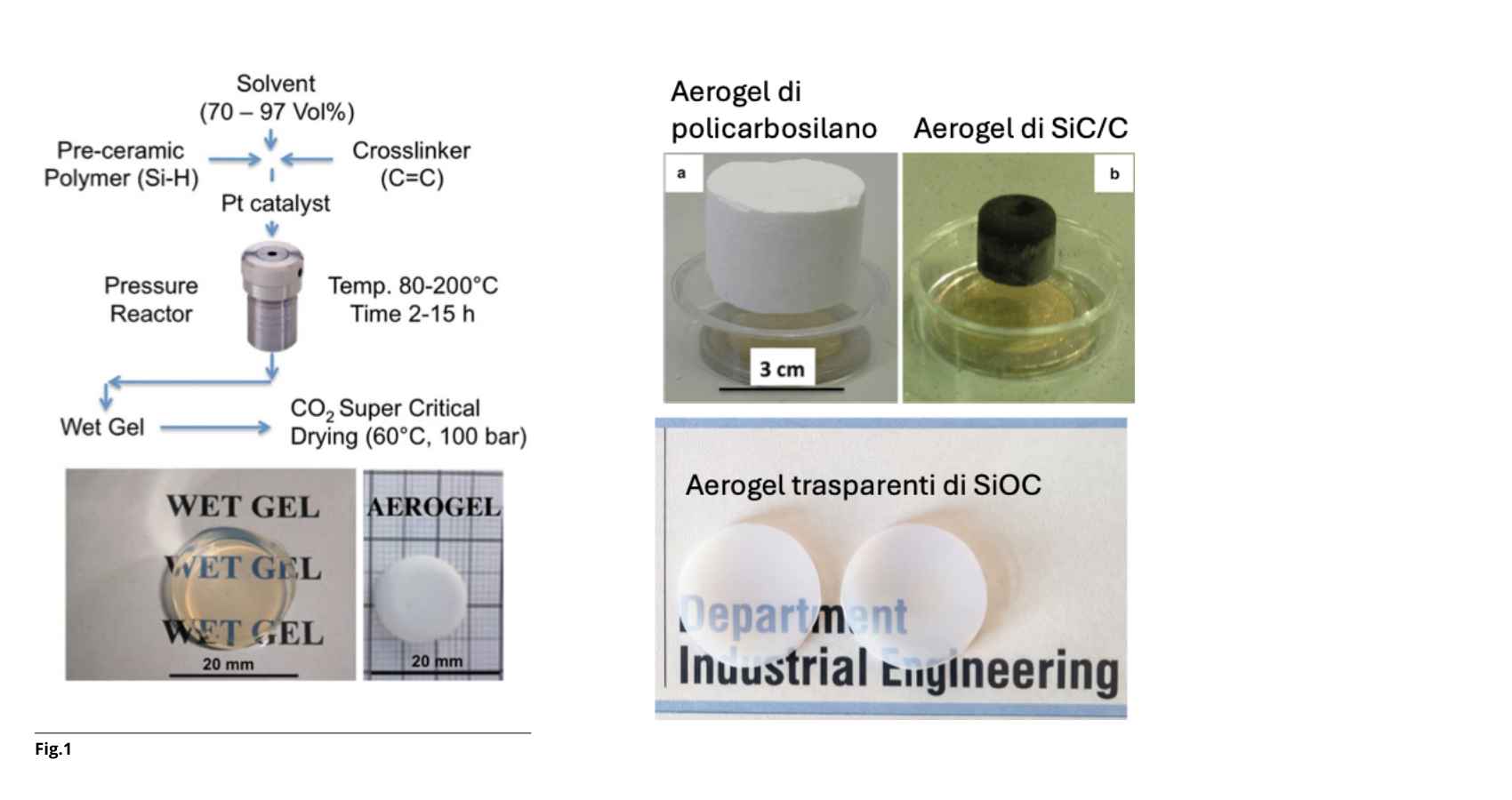
The synthesis process consists of three key stages:
Thanks to precise control of chemistry and process parameters, it has been possible to finely tune composition and microstructure. In particular, eliminating the carbon phase has enabled the production of transparent ceramic aerogels, combining lightness, thermal stability, and optical properties (Fig.1).
A further development involves the use of polymer preforms that are subsequently converted into ceramics. The process includes:
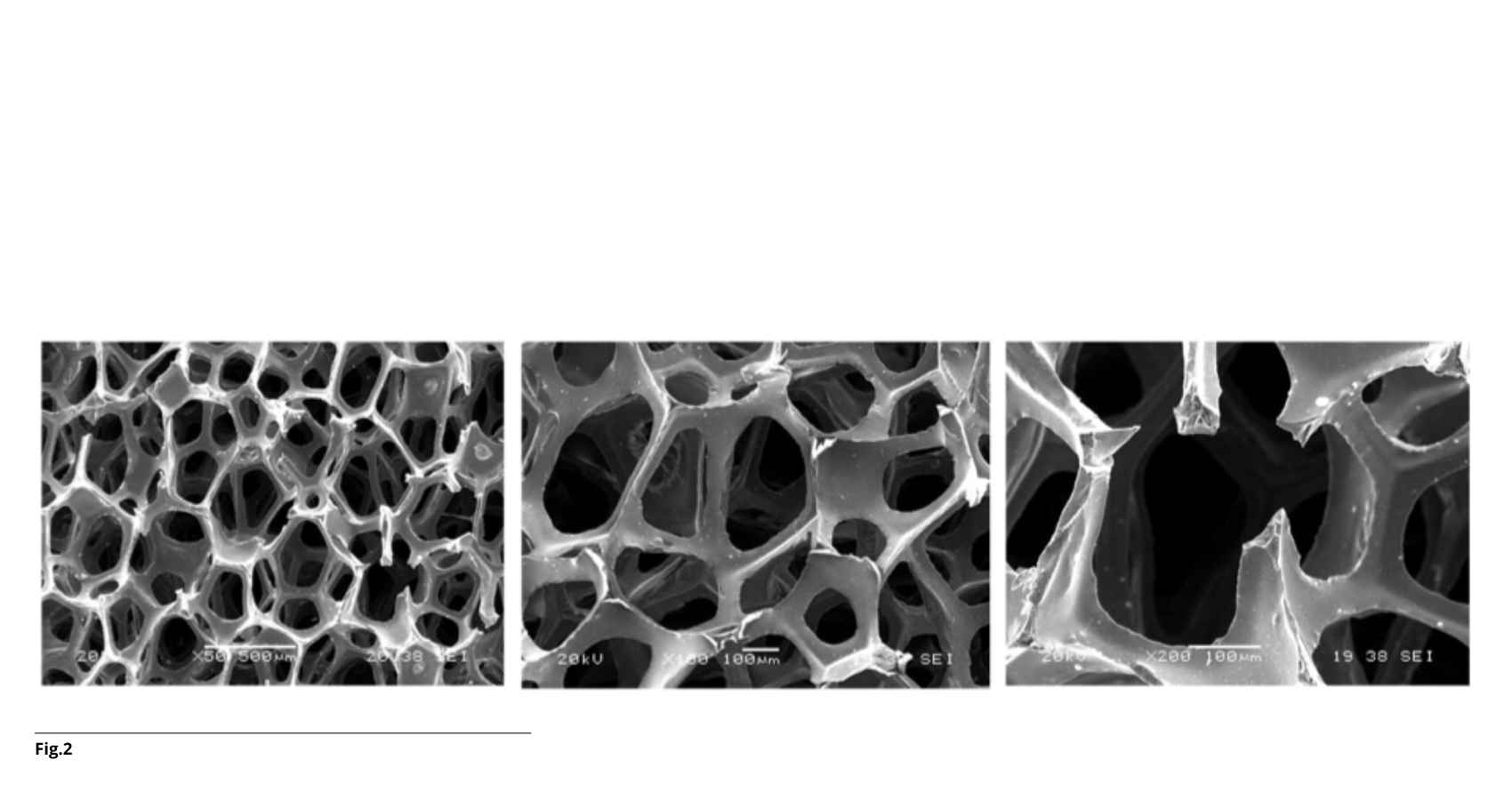
This strategy preserves the original geometry, transforming polymer structures—even highly complex ones—into lightweight, porous ceramic materials. Particularly interesting is the integration with 3D printing (FFF), which enables the design of highly controlled lattice structures. The polymer-to-ceramic transformation faithfully retains the designed architecture, opening new possibilities in the design of functional and structural materials. This approach naturally extends to the design of advanced ceramic composites. By using polymer filaments already loaded with a second phase (e.g., SiC particles or carbon fibers), it is possible to obtain, after pyrolysis, materials with significantly improved mechanical properties.
Examples include:
This strategy enables the design of “tailor-made” materials, combining lightness, strength, and high-temperature stability (Fig.2).
Today, PDC technology represents an extremely versatile platform, capable of connecting materials chemistry, advanced processing, and structural design. The contribution of the DII in this field demonstrates how it is possible to start from a fundamental discovery—the polymer-to-ceramic transformation—and arrive at concrete solutions, ranging from ultralight aerogels to structural composites and even transparent materials for advanced applications. A clear example of how fundamental research, interdisciplinary expertise, and innovation can converge in shaping the materials of the future.
Fig.1: The schematic of the synthesis process of polymer-derived preceramic aerogels is shown above. The photograph below the diagram shows the so-called “wet gel,” i.e., the aerogel in its initial stage where the pores of the three-dimensional structure are still filled with solvent. Next to it is the same sample after supercritical drying, a process that removes the solvent while preserving the integrity of the porous structure.
Fig.1: SiC/C foams obtained by infiltrating reticulated TPU foams with a preceramic polymer followed by pyrolysis are shown above.