Information magazine of the Department of Industrial Engineering
Università di Trento
The selective oxidation of olefins represents one of the key reactions in modern industrial chemistry. These compounds, characterized by the presence of one or more carbon–carbon double bonds, are at the basis of the production of polymers, fine chemical intermediates, solvents, and molecules of pharmaceutical interest. Among the most relevant transformations, the oxidative cleavage of the double bond enables the production of carbonyl compounds—aldehydes and ketones—widely used on an industrial scale. However, traditional processes often rely on strong and hazardous oxidants, such as potassium permanganate, hexavalent chromium salts, or ozone, leading to significant environmental impact, safety risks, and high energy costs.
In an industrial context increasingly oriented toward sustainability, these issues make the development of alternative approaches necessary. In this scenario, heterogeneous photocatalysis emerges as one of the key technologies of green chemistry: by exploiting light energy, it enables the activation of oxidation reactions under mild conditions (room temperature and atmospheric pressure), reducing both energy consumption and the use of hazardous reagents.
A further element of innovation is represented by the use of alternative oxidizing species. In particular, the nitrate radical (NO₃)—well known in atmospheric chemistry but still scarcely explored in chemical synthesis—emerges as a promising candidate for selective oxidation reactions.
The aim of this work was the development of an efficient, selective oxidative cleavage process for olefins, consistent with the principles of green chemistry. The proposed approach is based on the in situ generation of the nitrate radical through photocatalysis on titanium dioxide (TiO₂), thus avoiding the direct use of hazardous oxidants and reducing the formation of undesired by-products.
The distinctive element of this research lies precisely in the introduction of the nitrate radical into a controlled synthetic context, opening new perspectives for the use of highly reactive radical species in selective processes.
The main objectives of the work included:
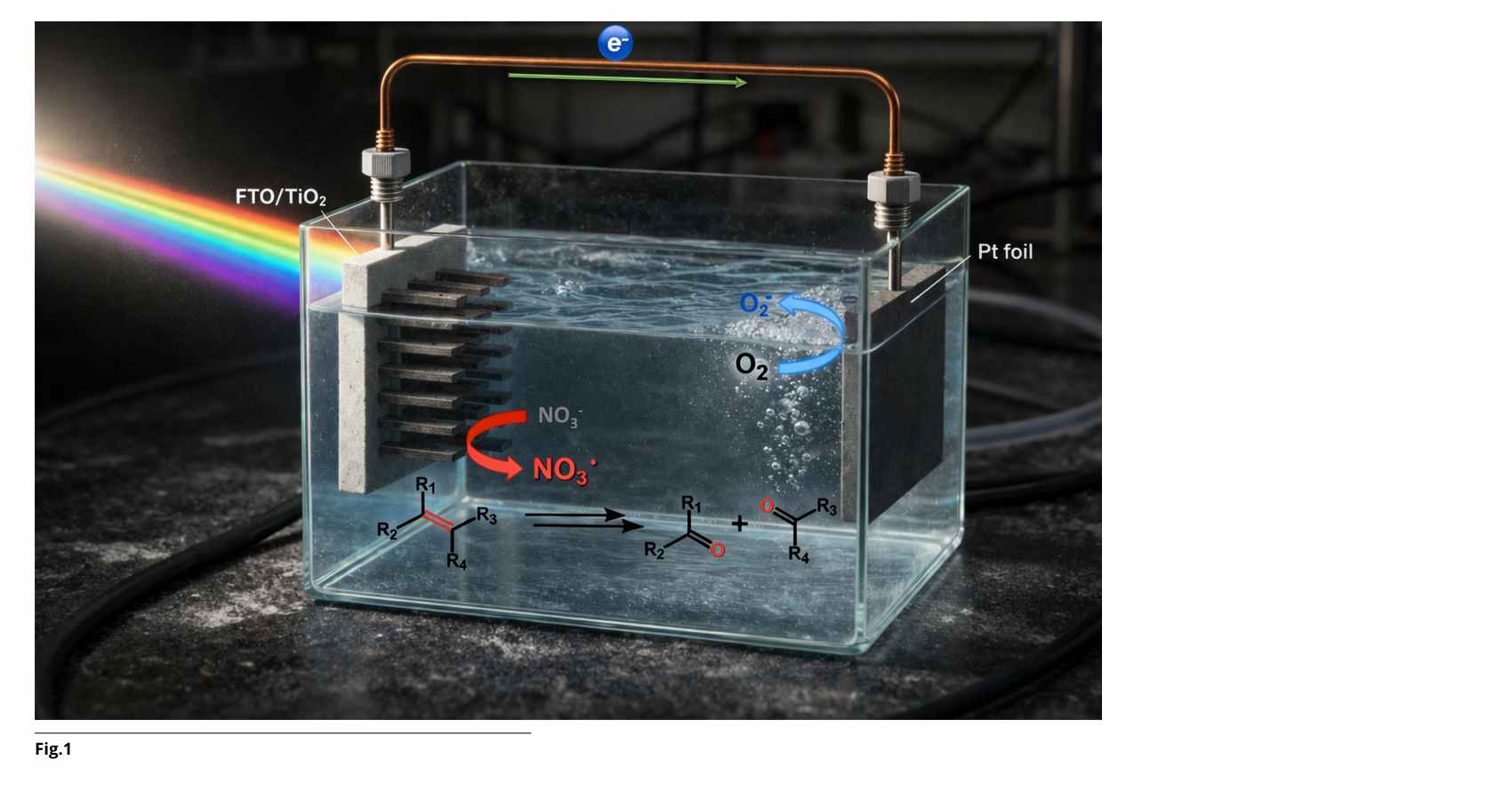
The developed system involves the generation of nitrate radicals from nitrate ions adsorbed on the TiO₂ surface, activated by light irradiation. This approach enables a safer and more sustainable advanced oxidation process.
Limonene, a renewable olefin, was used as a model substrate. Experimental results show that, in the presence of light, TiO₂, and nitrates, cleavage of the double bond occurs with the predominant formation of carbonyl products, confirming the active role of nitrate radicals.
System optimization highlighted the importance of key parameters such as nitrate concentration, photocatalyst loading, and TiO₂ surface characteristics. In particular, the interaction between nitrates and the catalytic surface proved to be crucial for the generation of reactive species.
To support the experimental results, theoretical studies based on ab initio methods and density functional theory (DFT) were conducted, validating the proposed reaction mechanism. At the same time, a quantitative kinetic model was developed, capable of describing the temporal evolution of the system and independently validating the experimental observations.
A further advancement was achieved through the introduction of electro-assisted configurations: the application of an external potential promotes the separation of photogenerated charges and allows the elimination of sacrificial reagents. The use of nanostructured TiO₂-based photoanodes demonstrated the robustness of the approach even in configurations closer to potential industrial applications.
Overall, the results demonstrate that nitrate radical-mediated oxidative cleavage of olefins can be effectively achieved under photocatalytic conditions, using TiO₂, UV-visible light, and nitrate ions as the source of the oxidizing species.
Integration with electrochemical approaches also makes it possible to eliminate sacrificial reagents, further improving process sustainability and paving the way for potential large-scale applications.
From a scientific perspective, this work redefines the role of the nitrate radical—traditionally confined to atmospheric chemistry—proposing it as a new tool for selective chemical synthesis.
Future perspectives include extending the method to other substrates, employing alternative photocatalytic materials, and developing more advanced photoelectrocatalytic systems.
In an industrial landscape increasingly attentive to the environmental impact of processes, this research fully aligns with the paradigm of green chemistry, demonstrating how innovation, sustainability, and applicability can progress hand in hand. The maturity of the results achieved is also evidenced by the initiation of patent protection activities, a concrete indicator of the technological potential developed.
Fig.: Illustration of the photoelectrocatalytic system developed to convert olefins into value-added carbonyl compounds through light activation and the formation of nitrate radicals.