Information magazine of the Department of Industrial Engineering
Università di Trento
In industrial supply chains, supplying production means organizing the collection of materials from numerous suppliers and their transportation to the plants where they will be used. Decisions must be made about which collections to carry out, on which days, and whether and how to combine them into the same trip, while ensuring that each material arrives within the time required by production.
These decisions become particularly complex when the network includes multiple plants and organizational units that share part of their supplier base. Information on production requirements, material availability and transportation is often collected and used at different times and by different parties. Without a common view, transportation may be organized separately, based only on the information available at a given moment. One decision can therefore affect subsequent ones, even when new information would suggest revising it, reducing opportunities to consolidate collections and make better use of vehicle capacity.
The supply chain disruptions of recent years have made the effects of this fragmentation particularly evident. Coordinating flows, however, is a daily challenge, especially in industries characterized by complex supply networks and a broad supplier base, such as the automotive sector and the manufacturing of industrial machinery and equipment. Addressing this challenge requires an overall transportation organization that can be updated as conditions change.
Even when demand varies, historical data can reveal recurring patterns that are useful for planning certain transportation services in advance. These patterns provide a general framework, while the daily plan must adapt to the flows actually available.
Another decision that needs to be updated is when to activate a transport. A short waiting period can make it possible to consolidate materials from different suppliers and make better use of vehicle capacity, but the available time window is often limited. In environments characterized by high product variety and variable production schedules, materials must be available within precise and generally short time frames. The waiting margin must therefore be assessed on a case-by-case basis, so that consolidation does not compromise service levels.
The research, developed in collaboration with the University of Bologna and the University of Ferrara, addresses this challenge by coordinating the information available across the entire network. Based on these data, it identifies recurring structures that can be used to consolidate flows and uses them to guide operational decisions and manage exceptions.
The starting point of the research was to integrate information originally distributed across different organizational units, with the aim of making it comparable and usable for planning across the entire network. The data were brought together in a single database and standardized by defining common criteria for representing suppliers, plants, movements, volumes and lead times. This created a shared language through which information that had previously been collected and used separately could be analyzed jointly.
The database covered one year of operations involving approximately 1,000 suppliers, more than ten organizational units and over 20 plants, for a total of more than 80,000 movements. The network analysis showed that around four out of ten suppliers serve at least two organizational units, with some cases of even broader overlap. This overlap in the supplier base provided the basis for identifying recurring relationships and subsequent opportunities for consolidation.
The first research stream combined temporal and geographical analysis of flows to identify the suppliers most suitable for defining recurring transportation structures, referred to as templates. For each supplier, the frequency of collections and their regularity throughout the year were analyzed. This initial selection identified approximately 200 recurring suppliers which, although representing a limited share of the overall network, generate more than 80% of the movements.
The selected suppliers were subsequently analyzed using two clustering techniques. The first, DBSCAN, made it possible to identify geographical areas with a higher concentration of suppliers, separating them from more isolated suppliers. Within the areas identified, a second algorithm, k-medoids, formed groups by considering not only geographical proximity but also compatibility in terms of service frequencies, operating days, volumes and vehicle capacity.
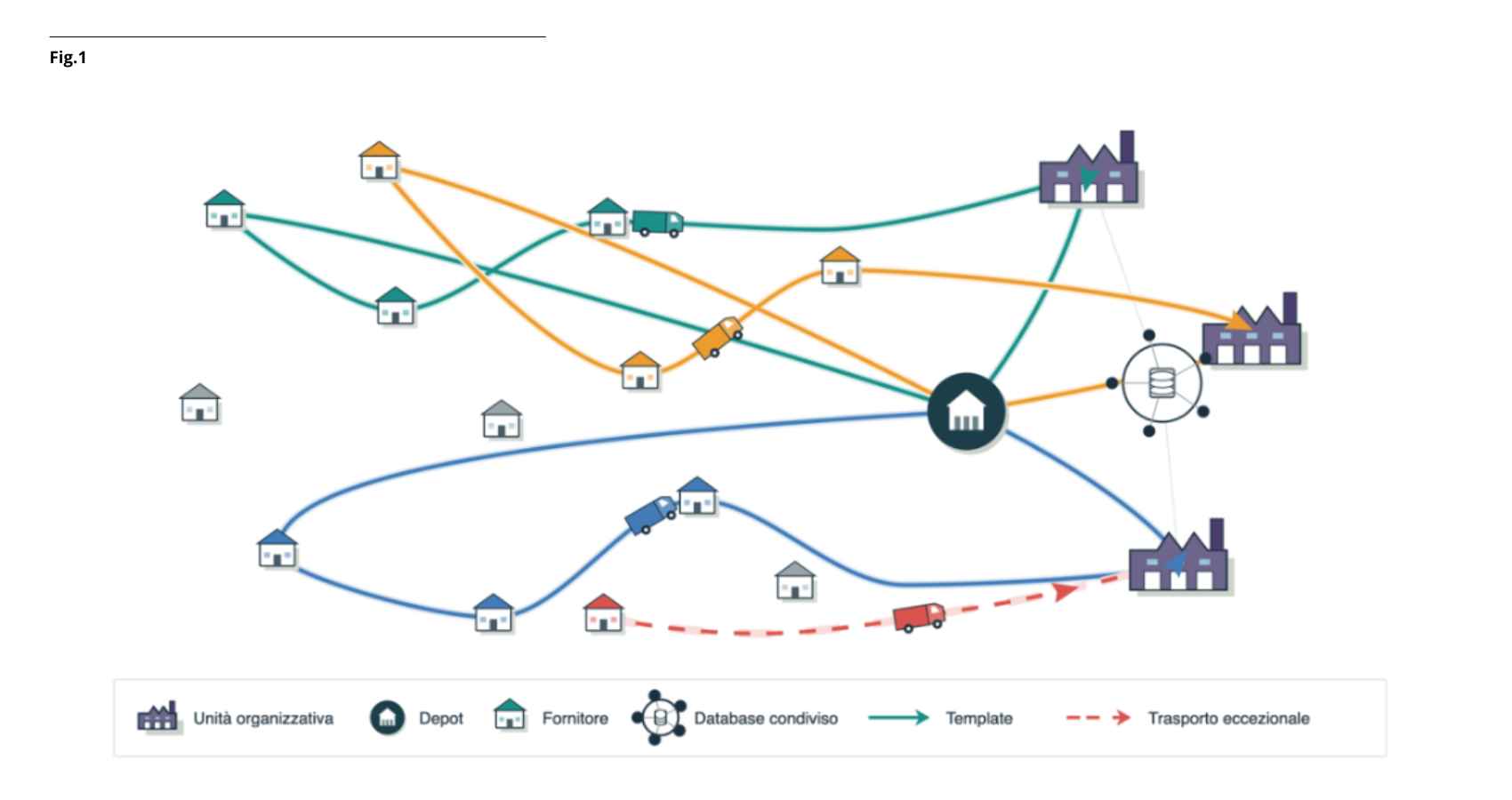
The analysis resulted in the definition of 24 transportation templates, each associated with a group of suppliers, a service schedule and a vehicle type. Most templates involve two to four weekly runs and the use of relatively small vehicles, while larger vehicles are assigned to groups characterized by higher volumes. These structures follow the logic of milk runs, in which the same vehicle makes recurring collections from multiple suppliers. In the case analyzed, however, the templates do not prescribe fixed routes: they define groups of suppliers, service schedules and vehicle types, leaving daily planning to adapt routes to the flows actually available.
The second research stream transformed the recurring structures into a tool for daily planning. At each daily update, the system acquires the latest available information, namely transportation requests, which are automatically assigned, whenever possible, to active templates or to those scheduled for the following days, while respecting the established service time windows. Requests that cannot be absorbed by the regular planning process are either included in other transports with available capacity or managed as exceptions, through a direct shipment or a short waiting period. Operational planning therefore does not reconstruct the entire transportation system from scratch every day, but uses recurring templates to guide assignments, focusing updates on changes and exceptions.
Routes are constructed using a progressive insertion heuristic, which adds new requests while respecting constraints related to vehicle capacity, trip duration, the maximum number of stops, the sequence of collections and deliveries, and vehicle availability. Alternatives are evaluated through an objective function that considers vehicle activation costs, distance traveled, the use of external carriers and a penalty associated with waiting. The model therefore balances the benefits of consolidation with service timeliness.
During the period analyzed, the daily plan was generated in less than three minutes on average, and the system handled approximately 95% of movements according to the logic described above. Compared with a purely reactive planning approach, based on the same heuristic but without recurring structures, costs were reduced by almost 10% and computation times by more than 70%, while respecting the time windows established for the service.
The case analyzed shows that the logic of milk runs can be extended to networks characterized by multiple collection and delivery points and by variable requirements and service frequencies. In these contexts, recurrence concerns the overall structure of the service rather than the rigid repetition of individual assignments or routes. Coordinated information, consolidation based on flow compatibility and dynamic plan updates therefore make it possible to combine a common view of the network with the operational specificities of different organizational units.
In the specific industrial context considered, the approach improved vehicle utilization and reduced both costs and planning times. The same logic can be adapted to other networks by building templates around their respective flows and introducing rules consistent with their materials, processes and service levels. The short computation times also make it possible to update the plan frequently, while more regular services can provide plants, suppliers and carriers with greater visibility into expected flows. Flow regularities can therefore be used to plan part of the transportation activity in advance. The remainder of the plan is updated according to operating conditions.
Figure 1. Example of supply flow planning using recurring templates and exceptional transportation movements.