Information magazine of the Department of Industrial Engineering
Università di Trento
How can we increase the range of electric vehicles and reduce their energy consumption without sacrificing acceptability and driving pleasure? This is the question at the heart of the Green Co-Driver project, a research initiative involving the University of Padua, the University of Trento, and Politecnico di Milano, which led to the development of a driving assistance system capable of combining energy efficiency with user acceptance.
For years, research has shown that a more attentive driving style can significantly reduce energy consumption. The secret of eco-driving is not driving slowly, but slowing down intelligently. Anticipating curves, exits, and changes in driving conditions makes it possible to take advantage of the vehicle’s natural deceleration, reducing the need for braking and therefore energy losses.
However, traditional eco-driving systems have an important limitation: users often perceive them as too slow, unnatural, or even boring. As a result, even when they are effective from an energy-efficiency perspective, they struggle to be accepted and used in everyday driving.
The idea behind Green Co-Driver is simple but innovative: minimizing energy consumption is not enough; the driver’s expectations and preferences must also be taken into account.
For this reason, the system was designed to balance two objectives that are often in conflict: on the one hand, energy savings, and on the other, the naturalness and comfort of driving. Green Co-Driver implements speeds and driving behaviors that reduce energy waste without sacrificing the smoothness and naturalness that make driving acceptable to users.
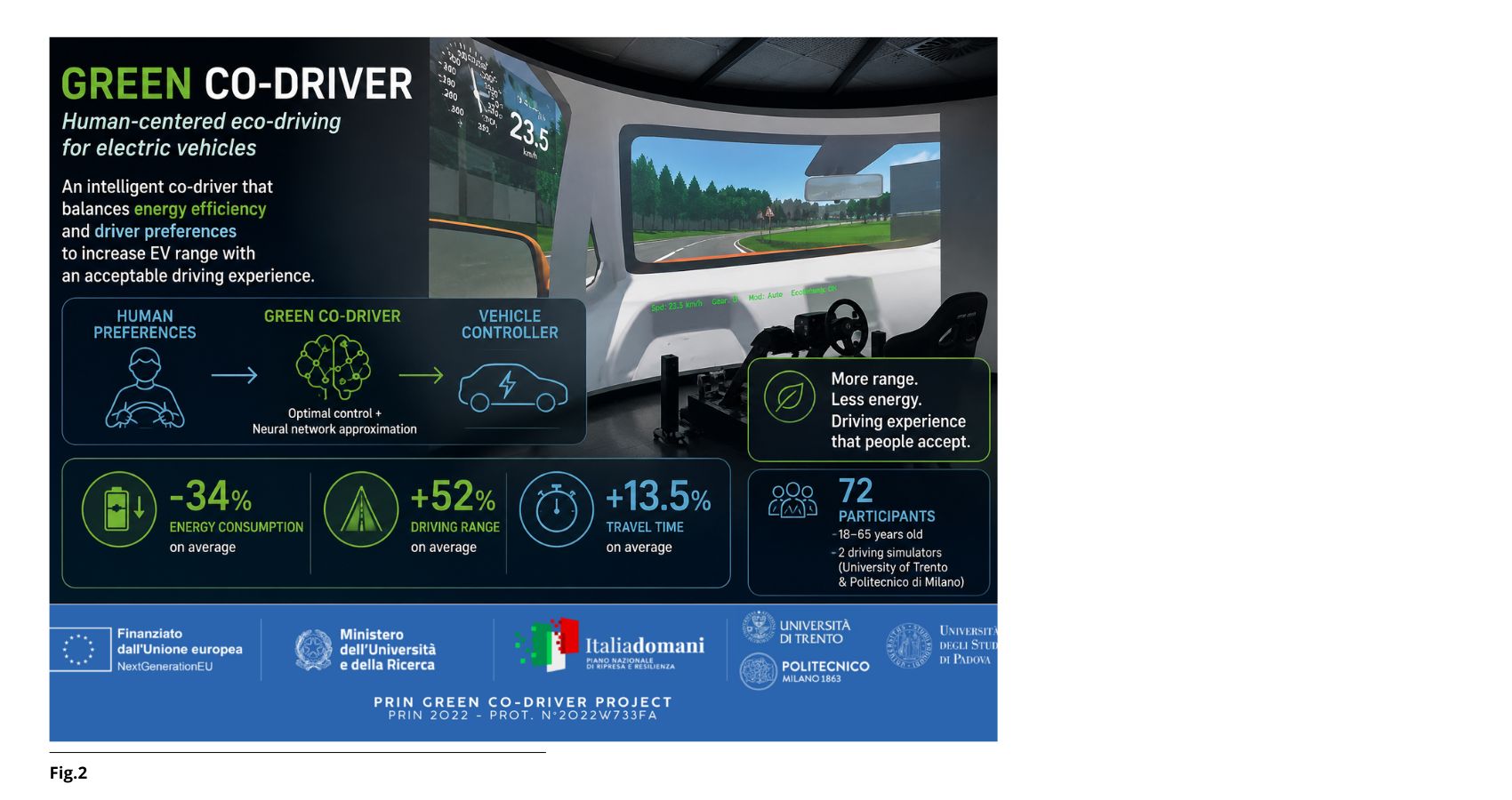
A distinctive feature of the system is the possibility of customizing this balance through a parameter that regulates the trade-off between energy efficiency and driver preferences. In this way, Green Co-Driver can adapt to different users, prioritizing greater energy savings or a driving style that is closer to individual expectations. During the project, different configurations were tested, and tests involving 72 participants made it possible to identify a solution that was particularly appreciated by users. This configuration achieves a reduction in energy consumption of approximately 34% and an increase in range of more than 50%, at the cost of an increase in travel time of approximately 13.5%, while maintaining a high level of acceptance.
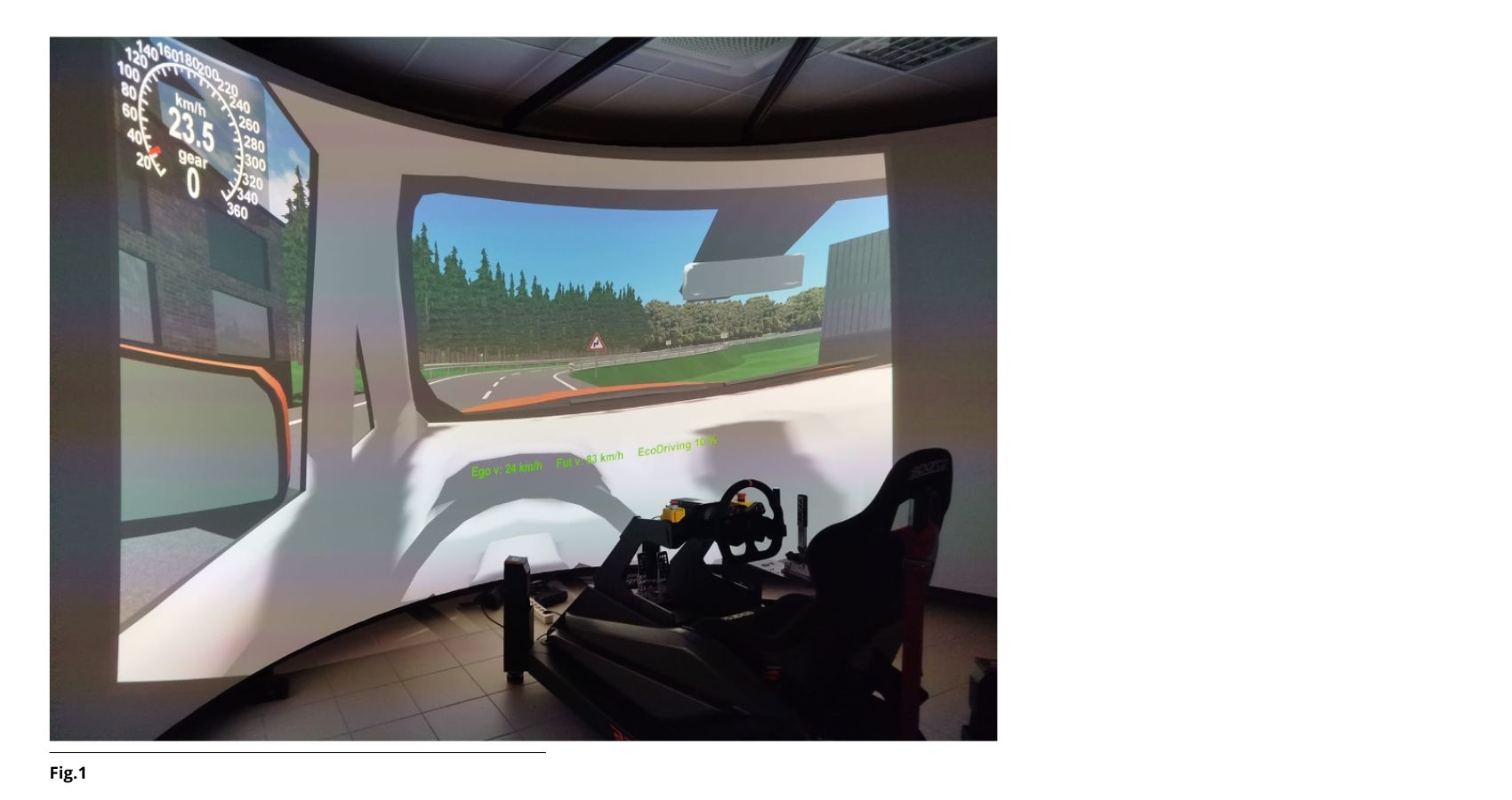
The system was validated by involving 72 participants aged between 18 and 65 in two different experimental campaigns. The tests were conducted using the dynamic simulator at Politecnico di Milano and the simulator at the Simulation and Virtual Reality Laboratory of the Department of Industrial Engineering at the University of Trento.
At the DII, the experiment involved volunteers from the Department, who contributed to the evaluation of the system by experiencing different driving modes and providing valuable feedback on the user experience.
In addition to measuring energy consumption and travel times, the researchers collected participants’ opinions to understand which balance between energy efficiency and comfort was most appreciated.
The results showed that a moderately energy-saving-oriented driving strategy can reduce energy consumption by approximately 34%, increasing the vehicle’s range by more than 50%, at the cost of an increase in travel time of approximately 13.5%.
The tests also showed that the system maintains highly consistent and repeatable driving behaviors, reducing the variability typical of human driving, which often leads to higher energy consumption.
Even more interestingly, most participants identified precisely this intermediate solution as the preferred one. Although they considered manual driving more enjoyable, users said they were willing to accept a slight increase in travel time when accompanied by a significant increase in vehicle range.
The project demonstrates how sustainable mobility technologies should be designed not only to optimize technical performance, but also to take people’s needs, habits, and driving experience into account.
Green Co-Driver represents a concrete example of the integration of driving models, simulation, and the study of human behavior, showing how significant energy benefits can be achieved without sacrificing an acceptable and natural driving experience.
The research also confirms the contribution of the Department of Industrial Engineering at the University of Trento to the development of advanced systems for smart, sustainable, and human-centered mobility.
For further information
IEEE Xplore – Green Co-Driver publication
Funding
PRIN 2022 Green Co-Driver project (Prot. 2022W733FA), funded by the Italian Ministry of University and Research and the European Union – NextGenerationEU, Mission 4, Component 2 (CUP E53D23003780006).
Fig.1: The driving simulator of the Simulation and Virtual Reality Laboratory of the Department of Industrial Engineering, used to test the Green Co-Driver system and evaluate eco-driving strategies with volunteers from the Department.
Fig.2: Graphical Abstract