Information magazine of the Department of Industrial Engineering
Università di Trento

Many modern engineering systems do not simply need to be described, but rather guided toward a specific objective. Whether dealing with a vehicle on a racetrack or a chemical reactor, optimal control provides the answers regarding which action should be taken at every instant. Since exact solutions are rare in real-world applications, numerical analysis acts as an indispensable bridge between the mathematical model and the final engineering decision.
In industrial contexts, making decisions does not mean selecting a single value, but defining a sequence of actions over time. Classical examples include vehicle braking, heating a chemical reactor, or regulating an offshore platform.
Optimal control systematizes these decisions through three pillars:
The key idea is that optimal control does not seek a simple final configuration, but rather a strategy: a time-dependent control law consistent with the system’s physics and operational constraints.
While simplified problems can be solved “by hand” in academic courses, real applications involve nonlinear equations, variables operating on different scales, and complex constraints. In these cases, analytical solutions are almost always unavailable.
Numerical analysis intervenes by transforming these continuous problems into finite models that can be solved by computers. This process makes it possible to:
The effectiveness of this approach becomes evident in very different fields:
A real-world problem consists of a complex chain of elements: derivatives, stopping criteria, discretization, and iterative algorithms. Current research focuses on developing scientific software capable of automating this chain.
The goal is to allow researchers to describe the problem at the physical level while the software automatically generates the required code. Nevertheless, engineering judgment remains essential for verifying the plausibility of the results and the sensitivity of the model.
Research in optimal control and numerical analysis is fundamental for:
Ultimately, this discipline transforms a complex engineering question into a verifiable computational process, providing a rigorous tool for decision-making in complex systems.
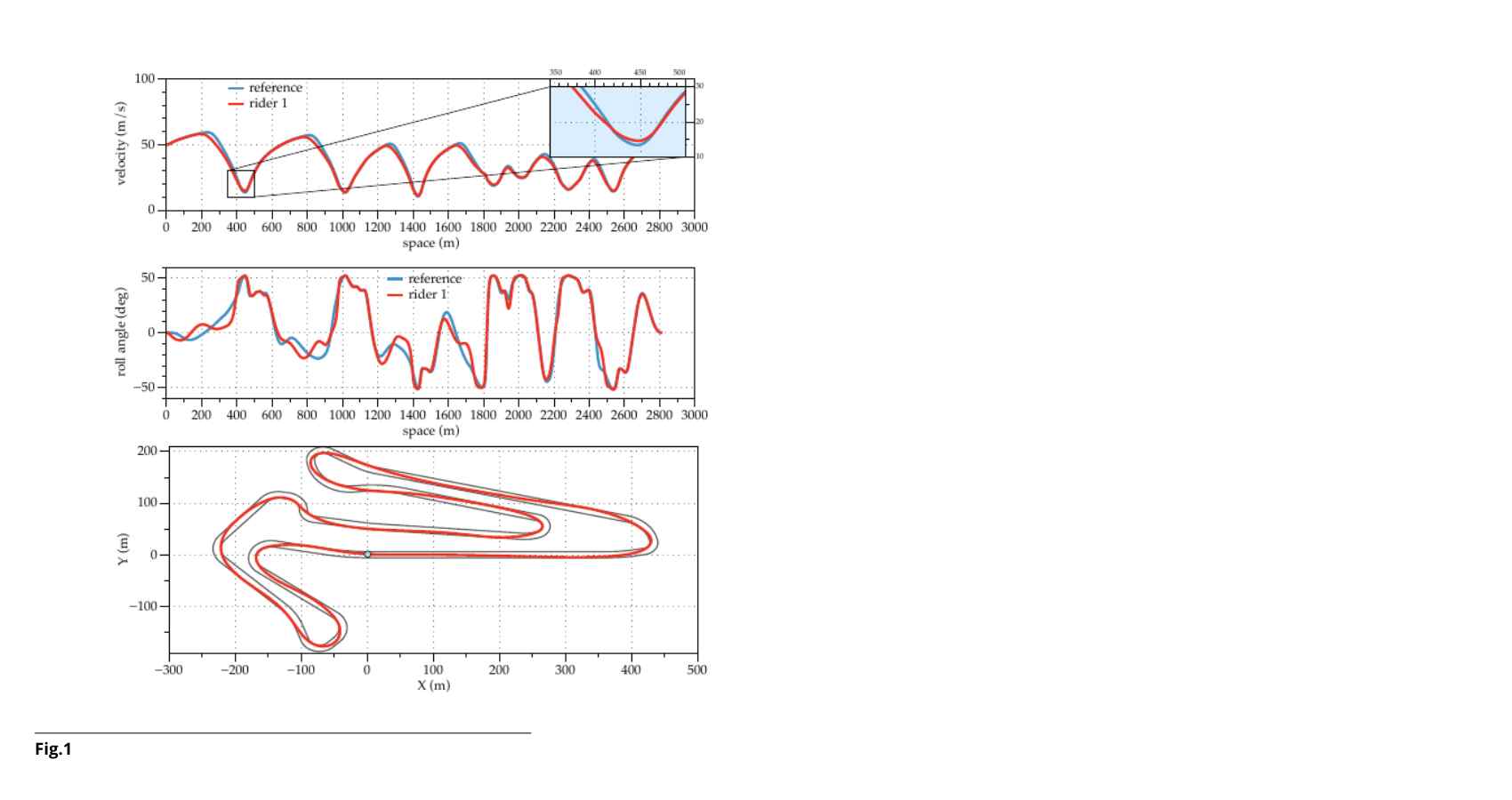
Fig. 1: Example of a result for a vehicle trajectory problem. Speed, angles, and path are interpreted together to understand the computed strategy, rather than as separate graphs.