Information magazine of the Department of Industrial Engineering
Università di Trento
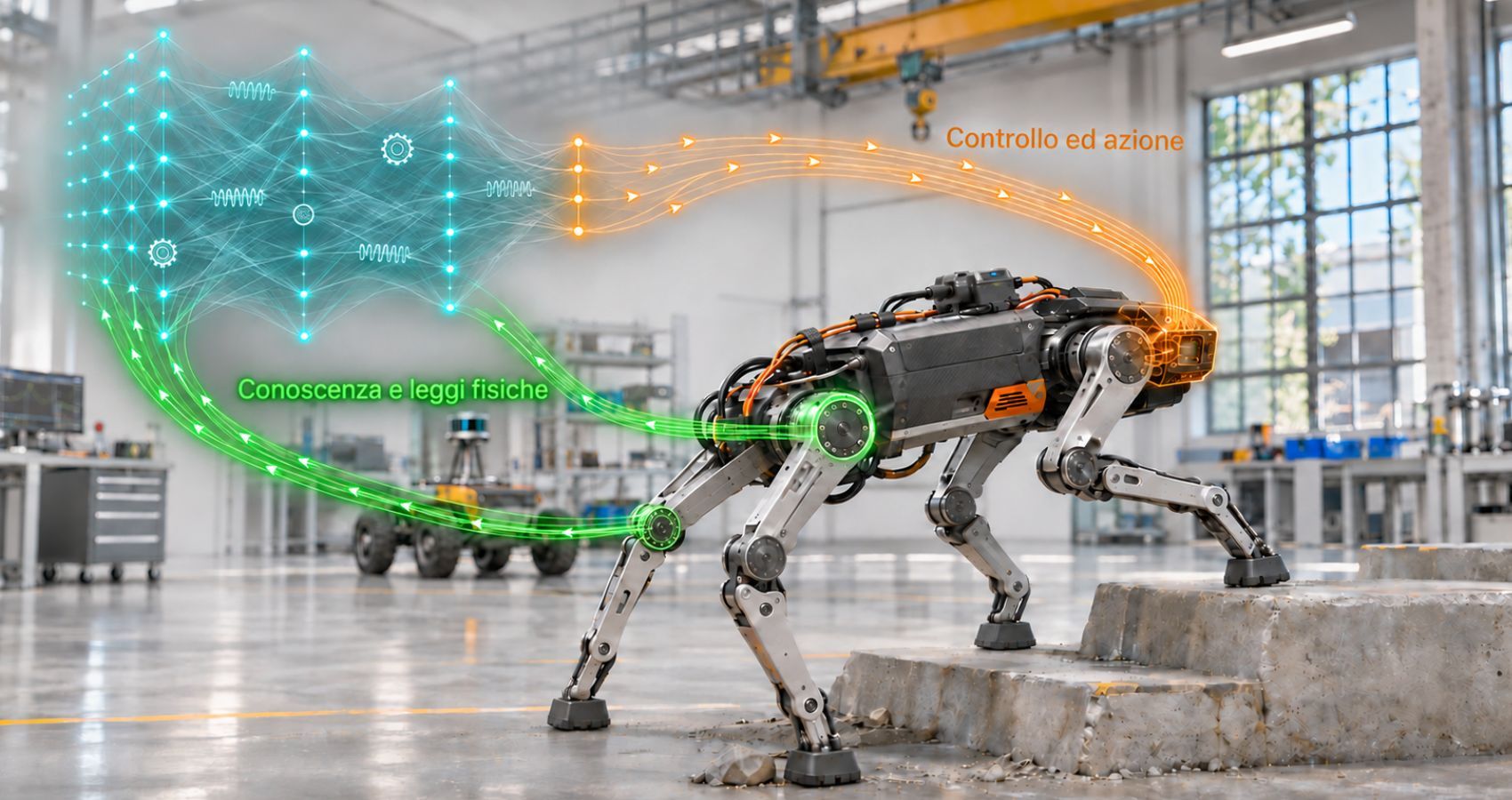
How can a robot learn to move around a factory, transport an object or adapt to unfamiliar terrain without having to experience every possible situation? This is one of the challenges addressed by Physical AI: artificial intelligence applied to systems that perceive and act in the physical world. This is the focus of Neu4mes, a project coordinated by Gastone Pietro Rosati Papini at the Department of Industrial Engineering of the University of Trento. The project aims to integrate knowledge of physics into neural networks to model and control autonomous systems.
As artificial intelligence makes its way into factories and logistics, interest is growing in robots capable of operating in changing environments, sharing spaces with people and adapting to different tasks. Vision and planning algorithms can already recognise obstacles and select routes; the challenge lies in translating these decisions into actions, interacting with the real world and its inherent variability.
Moving from the digital to the physical world introduces two fundamental challenges. The first concerns hardware: building a robot requires motors, sensors, mechanical structures and power systems, all involving trade-offs between precision, robustness, weight, autonomy and cost. Artificial intelligence must therefore operate within the practical limitations of the hardware on which it runs.
The second challenge concerns data. Large language models have been able to learn from enormous collections of texts, books and web pages. For robots, however, there is no equally vast and readily available repository of physical experiences. Collecting data requires conducting experiments, using equipment and investing time, while dealing with component wear and the risk of damage. Furthermore, data collected under specific conditions do not necessarily remain valid when those conditions change.
Two complementary approaches can help address this data shortage. The first is to generate experiences in increasingly realistic simulated environments, where robots can practise before entering the real world. However, accurately representing physical phenomena such as friction, deformation and contact remains a challenge.
The second approach is to make better use of available data by combining them with knowledge of physics. This is the idea behind Neu4mes.
In language, although grammatical rules exist, we do not have a set of equations capable of fully describing meaning, context and communication. This is why learning from data has taken on such a central role. For many physical systems, by contrast, we already know the fundamental relationships governing motion, forces and energy exchanges. Asking a neural network to rediscover all these relationships through experiments alone would mean overlooking a valuable body of existing knowledge.
The goal, therefore, is to incorporate what we already know into artificial intelligence, allowing data to identify unknown parameters and describe phenomena that are more difficult to model. For example, we may know the equations governing a robot’s motion while learning, through experiments, the parameters that determine its interaction with the environment.
The project’s first outcome is nnodely, a software framework for building Model-Structured Neural Networks: neural networks whose architecture reflects the knowledge available about the system being represented.
With nnodely, physical relationships can be incorporated into neural networks by assembling models that describe individual mechanical components and combining them to represent increasingly complex systems. The framework supports the entire process, from model definition to training, validation and export for deployment in real-world applications.
The aim is to develop models and control strategies that require less data while maintaining a connection with the actual functioning of the machine. The project investigates this approach in three experimental areas: wheeled vehicles, quadruped robots and drones. These are different platforms, but they all share the need to predict their own behaviour and adapt their actions to operating conditions.
The software is already available on GitHub under the open-source MIT licence.
Alongside the software, Neu4mes has a second planned outcome: a public wiki, currently under development, bringing together theoretical foundations, methods, design choices and case study results. It will serve as a reference for understanding how to integrate physical knowledge into neural networks and reuse the solutions developed by the project.
Open-source software and freely accessible shared knowledge are therefore two parts of the same goal: making these tools available to the scientific and industrial communities. The future of artificial intelligence in the physical world also depends on the body of knowledge we have built to understand it.
Further Information
Funding
The project FIS-2023-03684, “Structured Neural Network Framework for Modeling and Control of Autonomous Systems – Neu4mes”, is funded by the Italian Ministry of University and Research (MUR) through the Italian Science Fund (Fondo Italiano per la Scienza), under the FIS 2 call, with funding allocation decree no. 1236 of 1 August 2023, CUP E53C24003800001.