Information magazine of the Department of Industrial Engineering
Università di Trento
Total hip replacement is one of the great successes of modern orthopedic surgery. But “success” doesn’t mean “solved.” As people live longer and implants are expected to remain functional for decades, an important challenge remains: how can a metallic implant be made strong enough to support the body while behaving more like the living bone it replaces?
This question was investigated in a PhD project at the Department of Industrial Engineering of the University of Trento. The research explored how additive manufacturing can be used to produce titanium lattice structures with mechanical and biological properties tailored for future hip implants.
A hip implant lives a double life. It must withstand millions of loading cycles generated by walking and everyday activities. At the same time, it should support the attachment and growth of bone-forming cells, helping the implant integrate with the surrounding tissue.
The implant should mimic the mechanical properties of the natural bone. Conventional implants, being stiffer than the bone, carry too much of the mechanical load, leaving the surrounding bone under-stimulated. This phenomenon, known as “stress shielding”, may lead to bone loss and reduced implant stability.
Porous structures can reduce implant stiffness and create space for tissue ingrowth. Yet increasing porosity also lowers strength. The challenge is therefore to find the right balance between mechanical reliability and biological performance.
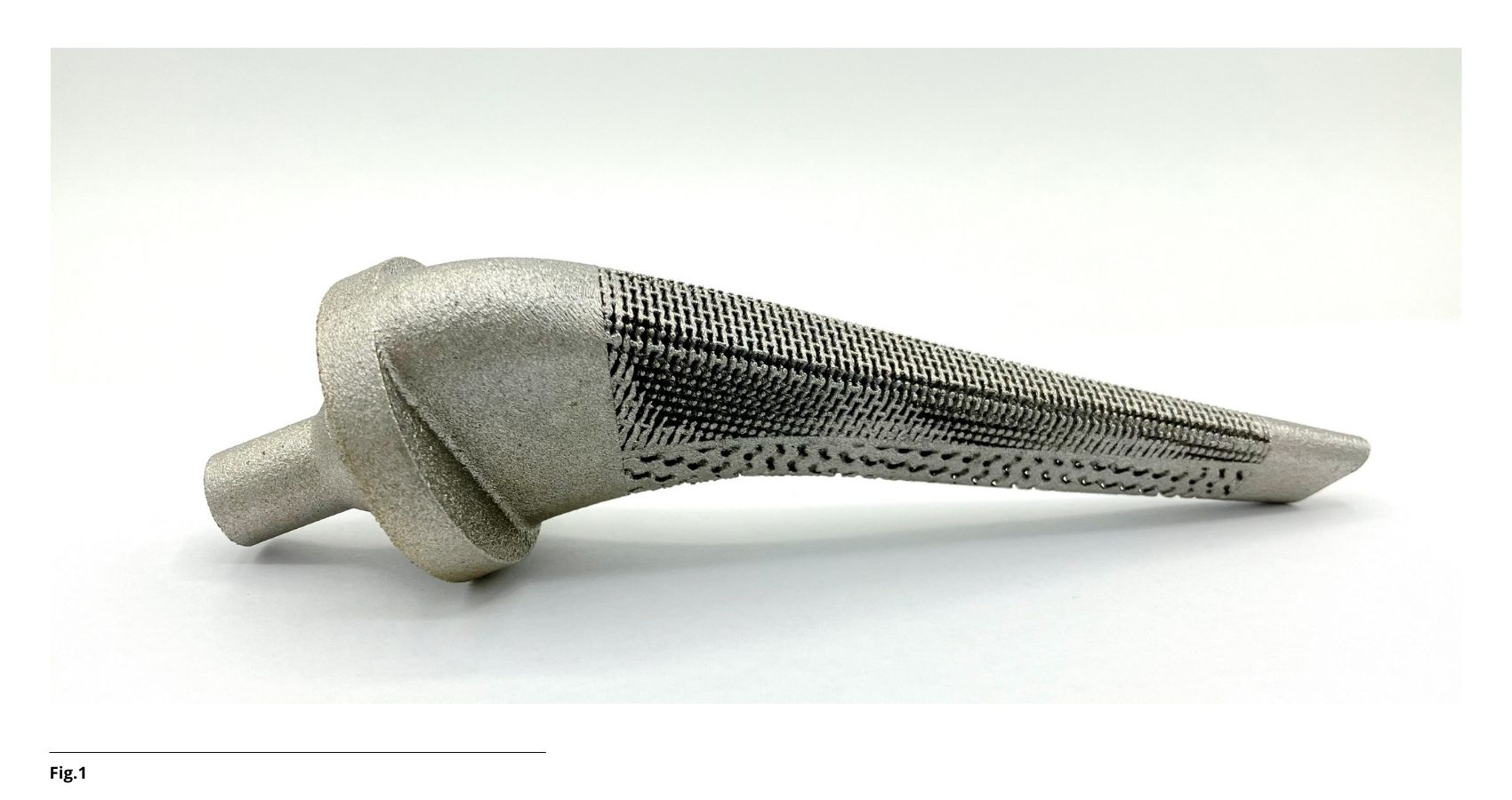
The project investigated lattice structures produced by laser powder bed fusion using β-Ti21S, a metastable beta-titanium alloy with lower stiffness than conventional titanium alloys, high strength, and promising biocompatibility.
Two different lattice architectures were studied.
The first was an auxetic re-entrant structure composed of bow-tie-shaped struts. Auxetic materials behave unusually: they expand laterally when stretched and contract laterally when compressed. Their high compliance makes them attractive for regions under compression to prevent bone-implant detachment. The second was a gyroid triply periodic minimal surface, or TPMS. Gyroid structures consist of smooth, continuously connected surfaces that distribute loads efficiently while providing interconnected pathways for fluid transport, cell migration, and tissue growth.
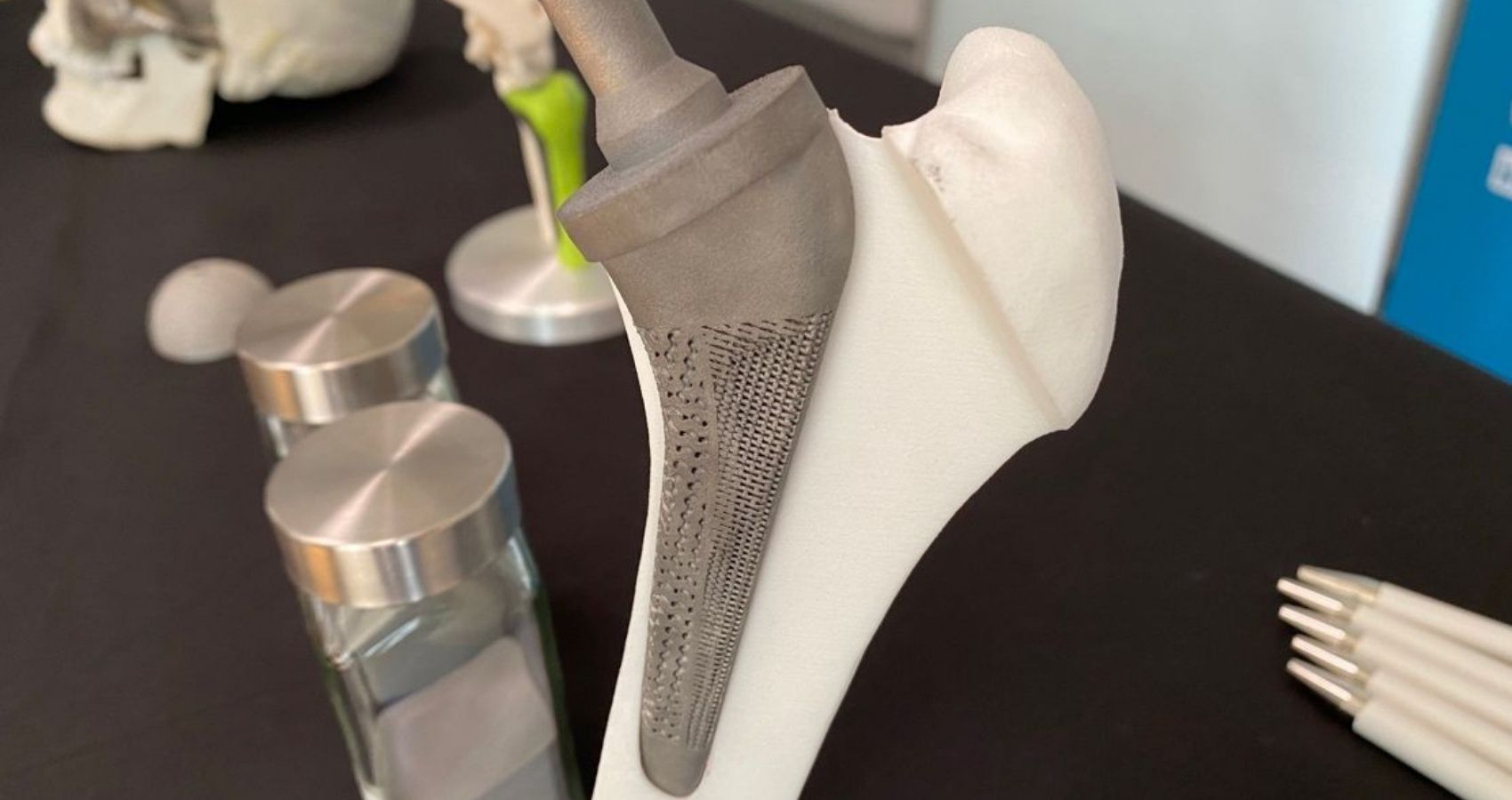
Rather than identifying one geometry as universally superior, the research considered the two designs complementary. The long-term concept is a multi-zone implant in which each architecture is placed where its specific mechanical and biological properties are most useful.
Before anything gets tested mechanically, it first has to actually come out of the printer the way it was designed. For complex lattices, producing the intended geometry is as important as designing it. Small changes in pore size, wall thickness or strut shape can strongly influence performance.
Micro-computed tomography was used to inspect the printed samples without cutting or damaging them. The reconstructed 3D structures were compared with the original digital designs, allowing dimensional deviations, attached powder particles and internal defects to be identified.
The analysis showed that printability is not merely a manufacturing concern. It directly affects the mechanical strength, fatigue resistance and biological performance of the final structure.
In each step of the project, different configurations of the lattices (single density and functionally graded porous) used in implant design were studied under gradually increasing loads and under repeated cyclic loading to evaluate stiffness, strength and fatigue resistance. The printed lattices achieved stiffness values within ranges associated with human bone. The TPMS structures behaved more like cortical bone, the dense outer layer of the femur, while the more compliant auxetic lattices were closer to cancellous bone, the porous tissue found inside it.
Biological testing was carried out using osteoblast-like cells and human bone-marrow-derived mesenchymal stem cells. Both lattice types were non-cytotoxic and supported cell attachment, spreading and increasing metabolic activity. Larger and better-connected pores generally produced more favorable cellular responses by improving the movement of cells, nutrients and culture medium through the structures.
Laser powder bed fusion naturally creates rough surfaces with “partially-melted powder particles”. Some roughness can support cell attachment, but excessive roughness and surface defects may reduce fatigue life and create a risk of loose particles.
Electropolishing reduced surface roughness by more than half in accessible regions and removed many residual particles. Importantly, the polished surfaces continued to support high stem-cell viability and osteogenic activity. This suggests that surface quality can be improved without sacrificing the biological advantages of the porous structures.
This research provides a framework for designing implants whose properties can be controlled through alloy selection, lattice geometry, porosity and surface treatment.
Getting a design like this from the lab bench to a patient’s hip is a long road. The next step is to test the total hip implant under realistic loading conditions. From there, the path runs through stages every implant has to clear before it can reach the operating room: in vivo studies in animal models, followed by clinical trials in humans to establish safety and effectiveness, and finally regulatory approval and the shift to reliable, standardized mass production.
In the future, medical imaging could also support patient-specific implants adapted to an individual’s anatomy and bone quality.
The broader goal is clear: instead of asking the body to adapt to a rigid metal implant, engineers can design the implant to behave more like bone.