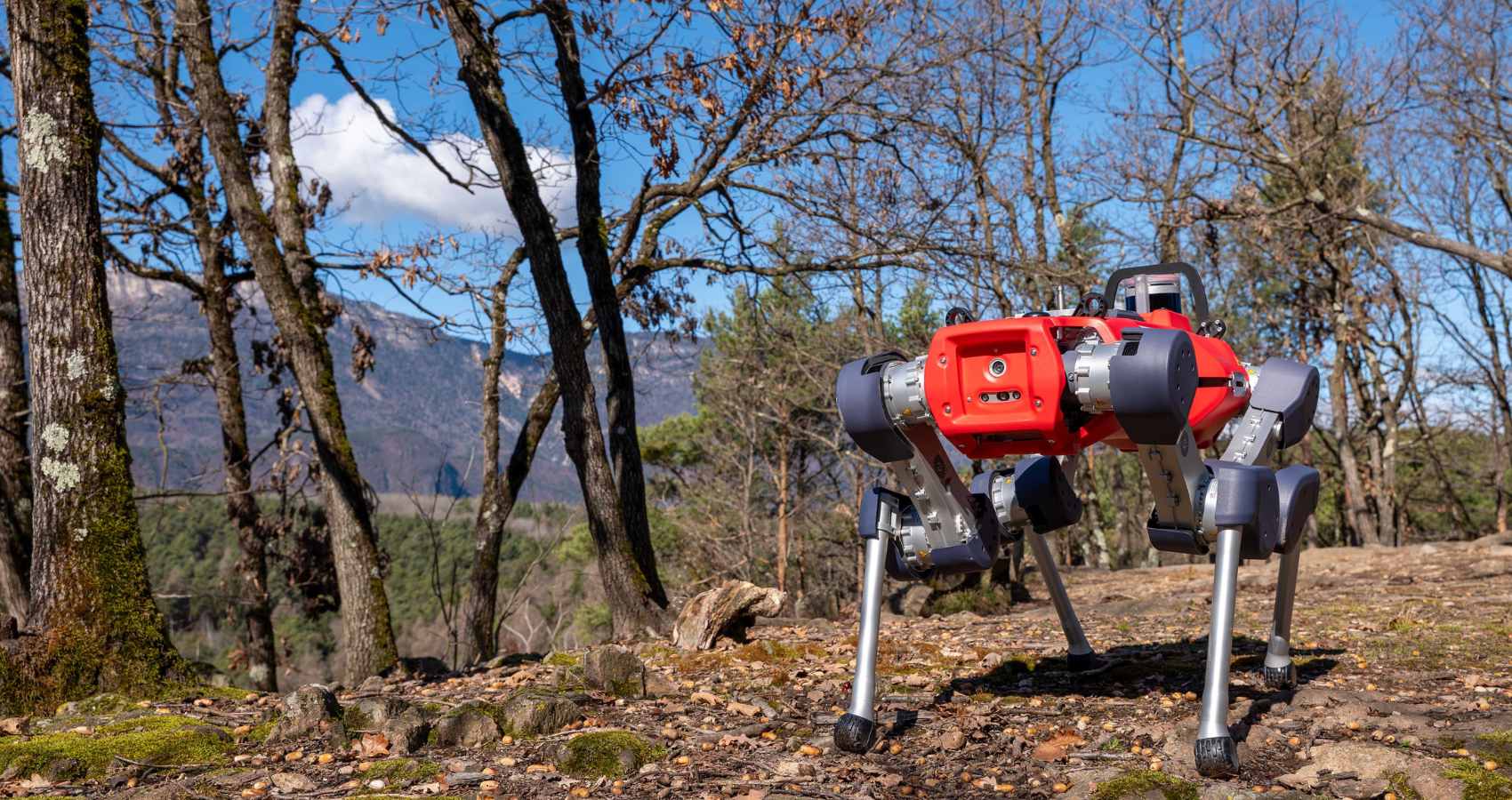
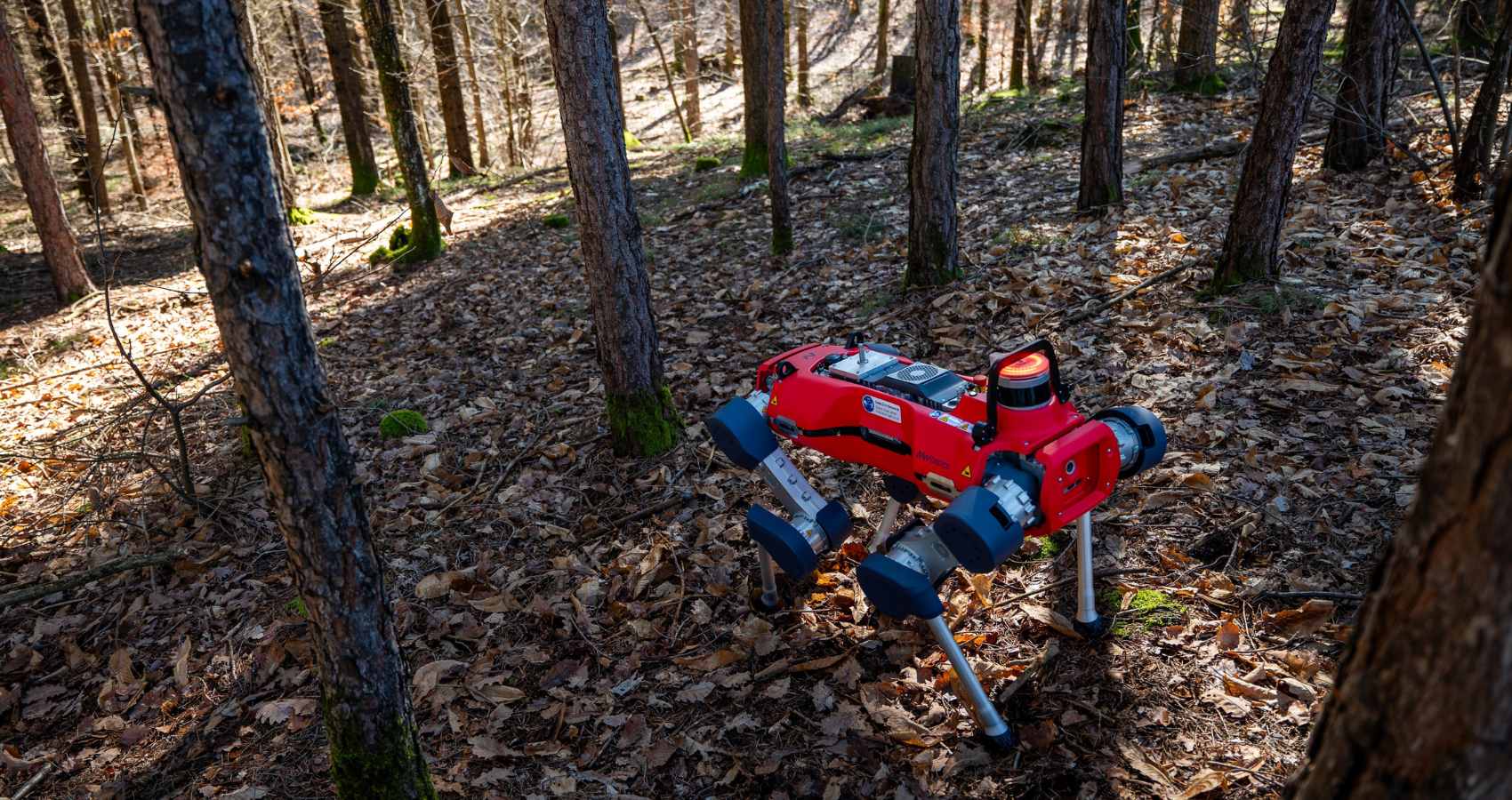
In collaboration with the Free University of Bozen-Bolzano, the research group led by Prof. Marco Camurri is developing new algorithms for autonomous navigation, localization, and mapping of the forests of Trentino-Alto Adige through the combined use of quadruped robots and drones.
Automated forest mapping: the Digiforest project
The European Horizon project Digiforest, currently nearing completion, has demonstrated the possibility of automatically mapping flat forests in the United Kingdom, Switzerland, and Finland using quadruped robots, handheld scanners, and drones operating both below and above the canopy. The collected data are integrated through Simultaneous Localization and Mapping (SLAM) algorithms, enabling the real-time creation of three-dimensional forest inventories.
These inventories include detailed geolocated information about trees (diameter at breast height (DBH), height, species, and health status), overcoming the limitations of current manual methodologies based on lengthy and difficult-to-scale field surveys. The automated updating of data paves the way for more dynamic forest management, which is essential in the context of increasingly rapid climate change.
Towards alpine forests: the FORMA project
The FORMA project (Forest Monitoring and Automation) extends this approach to alpine forests, which are denser and more difficult to access. The research focuses on two main directions: the development of advanced controllers based on Reinforcement Learning, in collaboration with Professors Del Prete and Saveriano, and the design of robust SLAM algorithms capable of operating in dense and moving vegetation environments.
Another innovative element is the integration of hyperspectral and multispectral cameras, which make it possible to analyze vegetation beyond the visible spectrum, enabling the early detection of water stress signals or the presence of pathogens such as bark beetles. The objective is to create volumetric forest maps that integrate geometric and semantic information, improving monitoring and intervention capabilities.
From robotics to the study of animal behavior
Alongside these activities, a collaboration involving the Free University of Bozen-Bolzano, the University of Linz, and the University of Sussex explores the use of quadruped robots for the study of animal behavior. In particular, the research analyzes the peering movement typical of the praying mantis, a rotational and translational head movement that enables the reconstruction of the background even in the presence of occlusions, such as dense vegetation.
This principle is connected to the concept of “synthetic aperture”: by combining multiple images captured from slightly different viewpoints, it becomes possible to reconstruct hidden information and focus on background elements, effectively making foreground obstacles transparent. The results show that, even with occlusions affecting up to 50% of the image, it is possible to obtain a sufficiently detailed reconstruction to allow advanced multimodal models to correctly recognize objects.
The study is currently available as a preprint: https://arxiv.org/abs/2511.16262
Photo credits: Free University of Bozen-Bolzano (Matteo Vegetti)