Information magazine of the Department of Industrial Engineering
Università di Trento
Imagine having to stop a fire not by extinguishing the flames one by one, but by removing from the air the oxygen that fuels them. This is more or less the idea behind bioMIPs, a new class of nanoparticles designed to recognize and “capture” target molecules with the precision of an antibody, but built entirely from naturally derived materials.
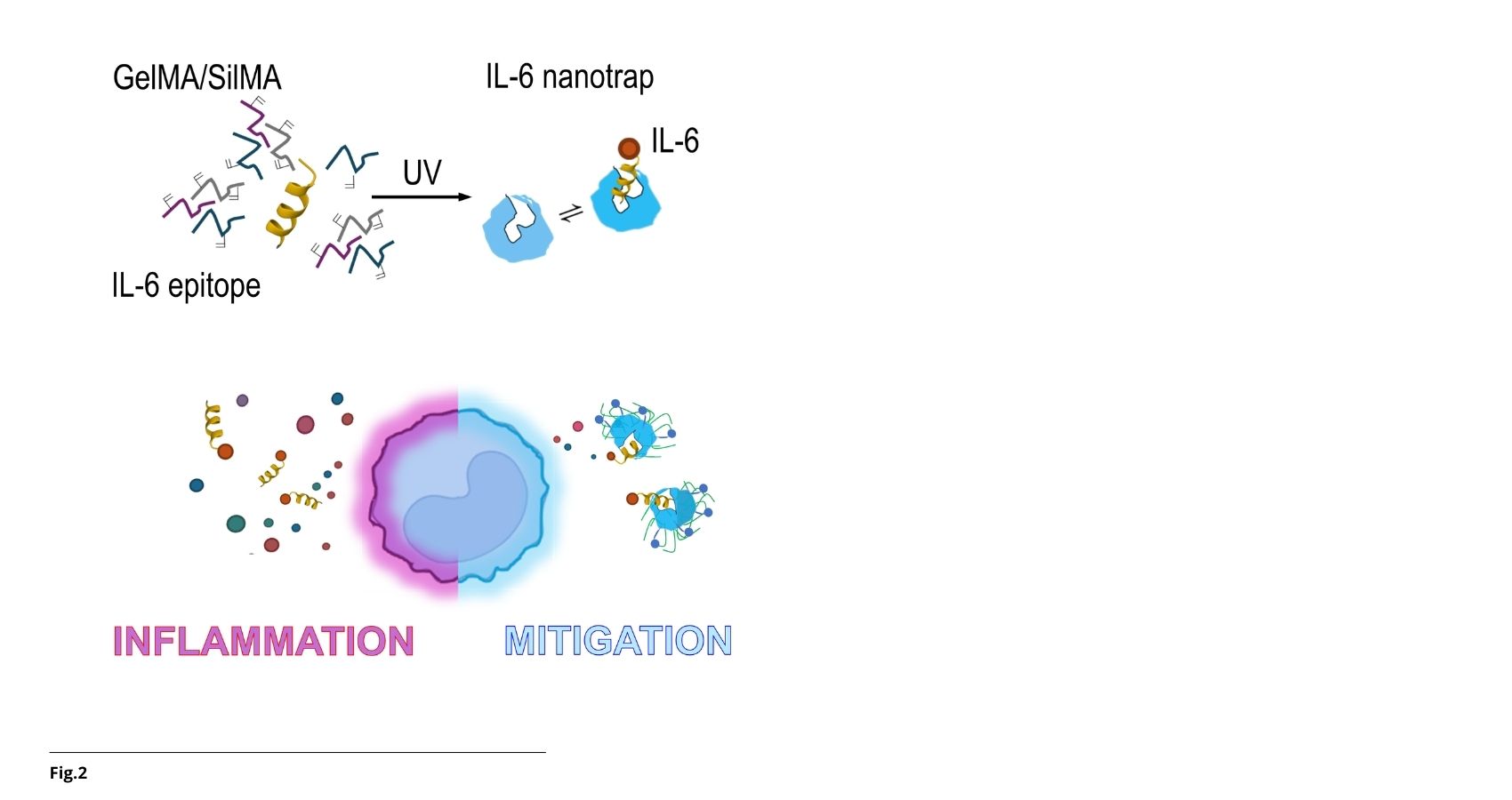
Many people will remember the expression “cytokine storm,” which became sadly familiar during the COVID-19 pandemic. Cytokines are the messenger proteins through which cells of the immune system coordinate with one another: normally, they orchestrate a measured defense aimed at supporting the body in the event of infections by modulating the inflammatory response and guiding the body toward recovery. However, under certain conditions, their production can increase uncontrollably. The result is cytokine storm syndrome, a systemic inflammatory reaction that can damage organs and tissues and become life-threatening. It is not limited to severe viral infections: it also occurs in sepsis, in many autoimmune diseases, and as a side effect of advanced immunological therapies.
Available therapies include monoclonal antibodies directed against individual cytokines such as interleukin-6 (IL-6), or broad-spectrum corticosteroid drugs that act systemically, causing significant side effects as well as substantial costs for our healthcare system.
What if, instead of chemically switching off these signals, it were possible to physically remove excess cytokines directly from biological fluids? This is where bioMIPs come into play.
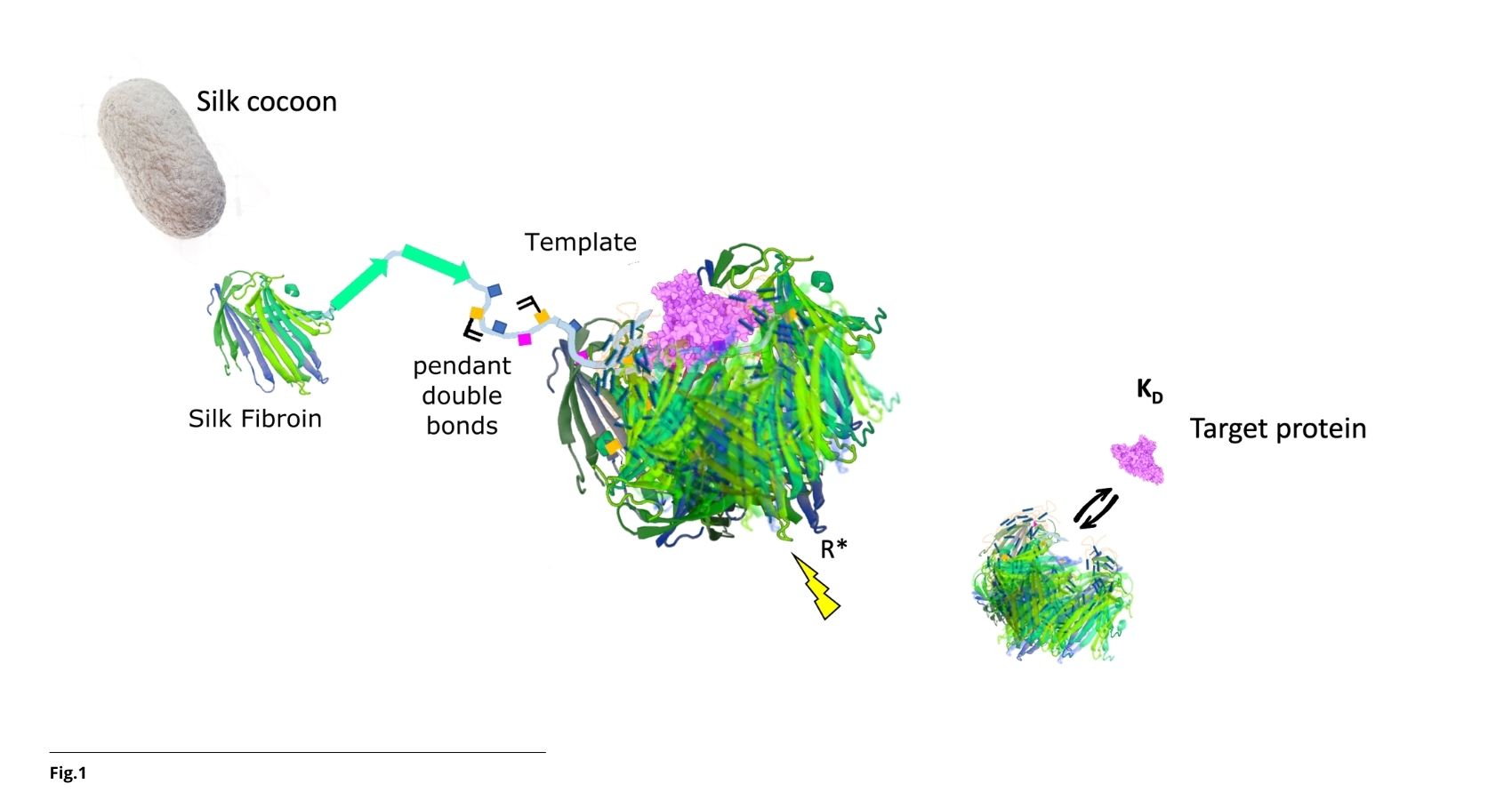
The acronym MIP stands for Molecularly Imprinted Polymer. The principle is elegant: a material is polymerized around the target molecule, just as plaster is cast around a key; when the target is removed, a cavity remains in the polymer that is chemically and geometrically complementary to it. That cavity acts as an artificial receptor, capable of recognizing and selectively binding precisely that molecule. For this reason, MIPs are often referred to as “plastic antibodies.”
The historical limitation lies precisely in their synthetic nature: traditional MIPs are built using acrylic monomers, which are poorly compatible with the body and non-biodegradable. The insight of the Trento and Verona research groups was to replace this chemistry with natural biopolymers such as silk fibroin or gelatin, subsequently made photocrosslinkable so that they can be shaped using light. The result is a new generation of “gentle” nanotraps: biocompatible, biodegradable into harmless by-products, sustainable and, in the future, potentially obtainable from waste materials generated by controlled production chains.
Not to copy nature, but to borrow its solutions: receptors that are made from the same materials as living organisms.
The technology did not emerge from nowhere. The first proof of principle demonstrated that nanoparticles made solely from silk fibroin could recognize albumin through a single high-affinity cavity (in the nanomolar range) and with dimensions of just 50–100 nanometers, while also proving to be non-toxic. This was followed by bioMIPs targeting hepcidin, a key hormone in iron metabolism, capable of quantifying it in serum and thus also opening the way to diagnostic applications; then came the development of methods to label them with fluorescent probes in order to track their fate inside cells and tissues. Finally, it was confirmed that bioMIPs are enzymatically degraded into non-toxic and safe fragments.
An important step toward a possible transition to clinical applications came with GelMA (gelatin methacrylate) nanotraps specifically designed to sequester interleukin-6, one of the key cytokines orchestrating inflammation. In inflammatory models, these bioMIPs behave like selective sponges: they absorb IL-6 while leaving the other surrounding cytokines and biomolecules intact.
This is precisely the challenge of the nanoTRiCKS project — tailor-made biopolymeric nanotraps for the suppression of cytokine storms. The goal is to develop nanoparticles capable of lowering cytokine levels by acting directly in biological fluids: a scenario aimed at sepsis, severe infections, autoimmune flare-ups and cytokine release syndromes associated with immunotherapies. Unlike conventional drugs, bioMIPs promise high selectivity and great stability, making it possible to avoid the cold chain; they can also be “tuned” to a specific target, meaning they can be designed in the laboratory to recognize a precise molecule. Finally, they are biodegradable, meaning they can be injected into the body without accumulating in the organism.
The clinical potential does not end with capture. Through the BIAS project, the same principles are transferred into polymeric supports designed to guide tissue regeneration: scaffolds incorporating bioMIPs aim to locally modulate inflammation and promote more orderly regeneration. These applications are complemented by diagnostic ones, such as biodegradable biosensors and wearable bioactive devices, as well as controlled drug-delivery devices and smart patches designed to guide wound healing. All of this is based, consistently, on natural and sustainable materials.
Behind bioMIPs lies the convergence of two complementary areas of expertise that, for the first time, have been integrated to create a new research direction. On the one hand, the expertise of Alessandra Maria Bossi (Department of Biotechnology, University of Verona) in molecular imprinting, the development of nanoMIPs for the recognition of proteins and peptides, and biosensing; on the other, that of Devid Maniglio (BIOtech Research Centre, Department of Industrial Engineering, University of Trento) in naturally derived biomaterials and bioprinting technologies.
The dialogue between two complementary research units, coming from fields that are only apparently distant, has given rise to an interdisciplinary platform integrating biomaterials, molecular imprinting, inflammation biology, applied mathematics and microfluidics. It is an example of how the cross-pollination of expertise can generate innovation: the precision of artificial receptors is combined with the biocompatibility and sustainability of naturally derived biomaterials, giving rise to a technology that brings together the strengths of both approaches.
Once again, nature proves to be the best source of inspiration for designing medicine that is more effective, sustainable and fully integrated with human physiology.
THE PROJECTS
nanoTRiCKS — Tailor-made biopolymeric nanotraps for cytokine storm suppression (PRIN 2022 PNRR, ID 20228AYRJE; UniVR & UniTN).
BIAS — bioMIPs Immunomodulating Scaffolds for tissue engineering (PRIN 2022 PNRR).
PNRR Funding – Mission 4, Component C2 – MUR / Italia Domani.
For more information: www.biomips.org