Information magazine of the Department of Industrial Engineering
Università di Trento
Through the SUSTAINANO project, funded by Fondazione Cariverona, the Department of Industrial Engineering and Verona-based startup Bioniks are developing sustainable processes to transform bacterially produced cellulose into nanofillers for biodegradable packaging, mortars and specialty papers.
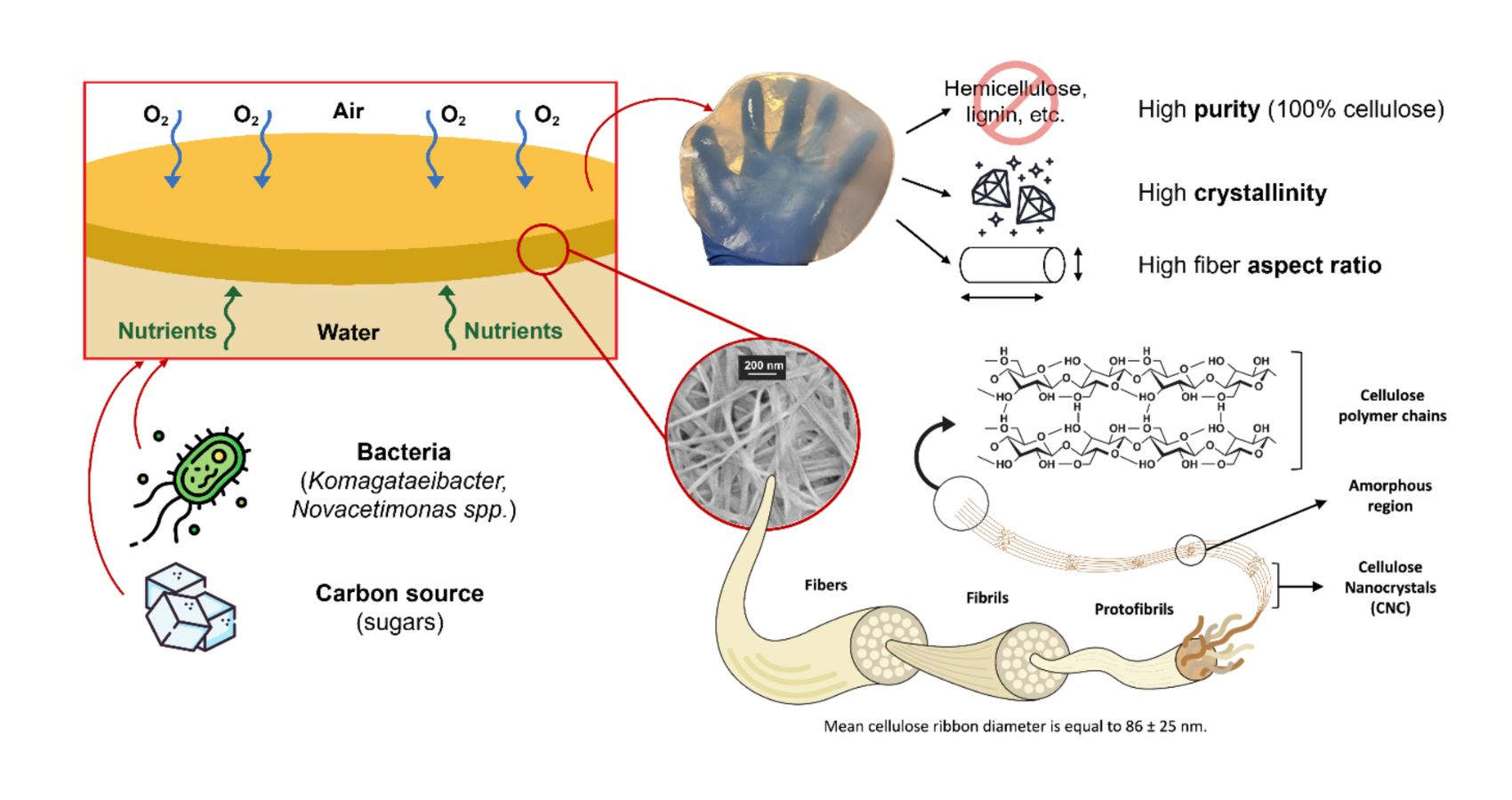
Figure 1. Bacterial cellulose, produced by specific bacterial strains in bioreactors, is characterised by high purity, crystallinity and fibre aspect ratio.
Bacterial cellulose (BC), produced by specific bacterial strains in bioreactors, is the key material at the heart of the SUSTAINANO project. Launched in December 2025, the project is funded by Fondazione Cariverona under its 2025 Research and Development Call.
Chemically, bacterial cellulose is identical to plant cellulose. However, in plants, cellulose occurs as micrometre-sized fibres accompanied by lignin and hemicellulose, which must be removed through aggressive chemical treatments for many applications. Bacterial cellulose, by contrast, is produced in an almost pure form (over 99%) and organised into a three-dimensional network of nanofibres, typically 20–100 nanometres in diameter. These fibres are ten to a thousand times thinner than the fibres found in the pulp used in papermaking. BC also tends to exhibit higher crystallinity than plant cellulose, reaching values of around 95% (Figure 1).
There is, however, a major obstacle. Bacterial cellulose nanofillers are currently available on the market only in limited quantities, because standardised processes for converting the membrane into an additive ready for industrial use are still lacking. This is precisely the gap that SUSTAINANO aims to address.
To use bacterial cellulose as a nanofiller, its interwoven network must first be opened up so that the individual fibres can be separated. This process is known as fibrillation. The project focuses exclusively on scalable, solvent-free mechanical techniques, including wet grinding, sonication, homogenisation using an Ultra-Turrax disperser, ceramic disc milling, high-pressure homogenisation and other technologies available at the Department of Industrial Engineering (DII) and through its partners.
The goal is to obtain particles no larger than 700 nm, while comparing the different methods in terms of their environmental impact through life cycle assessment (LCA).
Initial results show that high-pressure homogenisation breaks down the fibre network more finely than wet grinding, producing suspensions with lower viscosity that remain more stable even under high shear stress.
Measuring the resulting material also requires careful consideration. Particle sizing by laser diffraction (DLS), one of the most widely used methods for measuring particle size, interprets particles as spherical, whereas bacterial cellulose consists of long, flexible fibres. The resulting value is therefore an equivalent diameter of the aggregates rather than the actual fibre thickness, and it may vary depending on the time elapsed between dispersion and measurement.
For this reason, the project’s initial phase was devoted to an extensive review of the scientific and patent literature, which helped identify the most suitable set of characterisation techniques, ranging from electron microscopy and rheology to X-ray diffraction and infrared spectroscopy.
The first testing ground is biodegradable food packaging. The nanofillers will be incorporated into matrices such as poly(lactic acid) (PLA), polyhydroxybutyrate (PHB) and thermoplastic starch, with the aim of increasing stiffness and tensile strength while improving the barrier properties against oxygen and carbon dioxide.
The dense nanofibre network forces gas molecules to follow a tortuous path, slowing their diffusion. Films made entirely from bacterial cellulose can also block much of the ultraviolet radiation, helping protect food from oxidation.
Research already carried out at DII has provided valuable insights. Switching from millimetre-sized flakes dried in an oven to nanoscale aerogels obtained by freeze-drying has significantly improved filler dispersion in thermoplastic matrices. This has helped avoid the loss of tensile strength and elongation at break observed with the flakes.
The project will explore new strategies for producing more homogeneous films and, in the longer term, enabling so-called smart functionalities. By combining bacterial cellulose with conductive materials such as graphene oxide or MXenes, it may be possible to develop packaging capable of monitoring humidity, pressure or package integrity.
The second application area is cementitious mortars. Very small amounts of bacterial cellulose—on the order of a few tenths of a percentage point—can affect workability, shrinkage and porosity. The literature reports that adding 0.15 wt% bacterial cellulose in suspension reduces the viscosity of fresh mortar and produces a denser microstructure [1].
However, the available literature remains limited and sometimes contradictory. Some studies report better results with powdered cellulose, while others favour gel-based formulations. Moreover, the properties of the original filler are rarely described in sufficient detail.
SUSTAINANO will seek to clarify these findings by correlating the degree of fibrillation with the final material performance.
Finally, using the 3D printer for cement-based materials at the Department of Civil, Environmental and Mechanical Engineering (DICAM), the project will also investigate additive manufacturing applications, such as the production of customised interlocking bricks.
The third area is specialty paper, in collaboration with Favini. When added to the pulp, bacterial cellulose can increase the paper’s tensile, tear and burst strength by 30–40%, as demonstrated by published studies [2,3]. When applied as a coating, it can instead improve resistance to grease and water vapour while modifying the surface finish. Unfortunately, here too, the scientific literature provides very little specific information about the initial properties of BC, including suspension viscosity and concentration, as well as aggregate size and morphology. Pilot trials will therefore be conducted directly at the company’s facilities.
SUSTAINANO runs for 24 months and brings together complementary areas of expertise. Bioniks Srl, a Verona-based startup established in 2022, produces bacterial cellulose and optimises its fermentation process. Favini Srl, a long-established paper manufacturer based in Rossano Veneto, contributes its expertise and industrial facilities for paper applications. The Department of Industrial Engineering at the University of Salerno contributes its experience in the production of cellulosic nanofillers. At the University of Trento, the DICAM department works on cementitious materials, while the Department of Physics carries out gas permeability measurements.
The project’s final objectives include the development of at least three demonstrator prototypes, one for each application; the filing of at least one patent or utility model application; and the publication of at least four scientific papers. The project also invests in people. Alongside a contract for an early-career postdoctoral researcher, it provides research grants for recent graduates and supports several undergraduate and master’s theses. From the bioreactor to packaging, walls and sheets of paper, the challenge is to demonstrate that a material produced by bacteria can become a reliable, sustainable and competitive ingredient for industry.
[1] Soares, T. V., Effting, C., Miranda, K. W., Schackow, A. (2024). Application of bacterial nanofibrillated cellulose for performance improvement in vermiculite lightweight mortar. Construction and Building Materials, 449, 138474.
[2] Tabarsa, T.; Sheykhnazari, S.; Ashori, A.; Mashkour, M.; Khazaeian, A. Preparation and characterization of reinforced papers using nano bacterial cellulose. International Journal of Biological Macromolecules 2017, 101, 334–340.
[3] Campano, C.; Merayo, N.; Negro, C.; Blanco, Á. Low-fibrillated bacterial cellulose nanofibers as a sustainable additive to enhance recycled paper quality. International Journal of Biological Macromolecules 2018, 114, 1077–1083.
THE SUSTAINANO PROJECT – Sustainable Development of Versatile Bacterial Cellulose Nanostructures for Advanced Industrial Applications. Funded by Fondazione Cariverona under the 2025 Research and Development Call (December 2025 – November 2027). Partners: Bioniks Srl; Favini Srl; University of Salerno – Department of Industrial Engineering; University of Trento – Department of Civil, Environmental and Mechanical Engineering (DICAM) and Department of Physics.