Information magazine of the Department of Industrial Engineering
Università di Trento
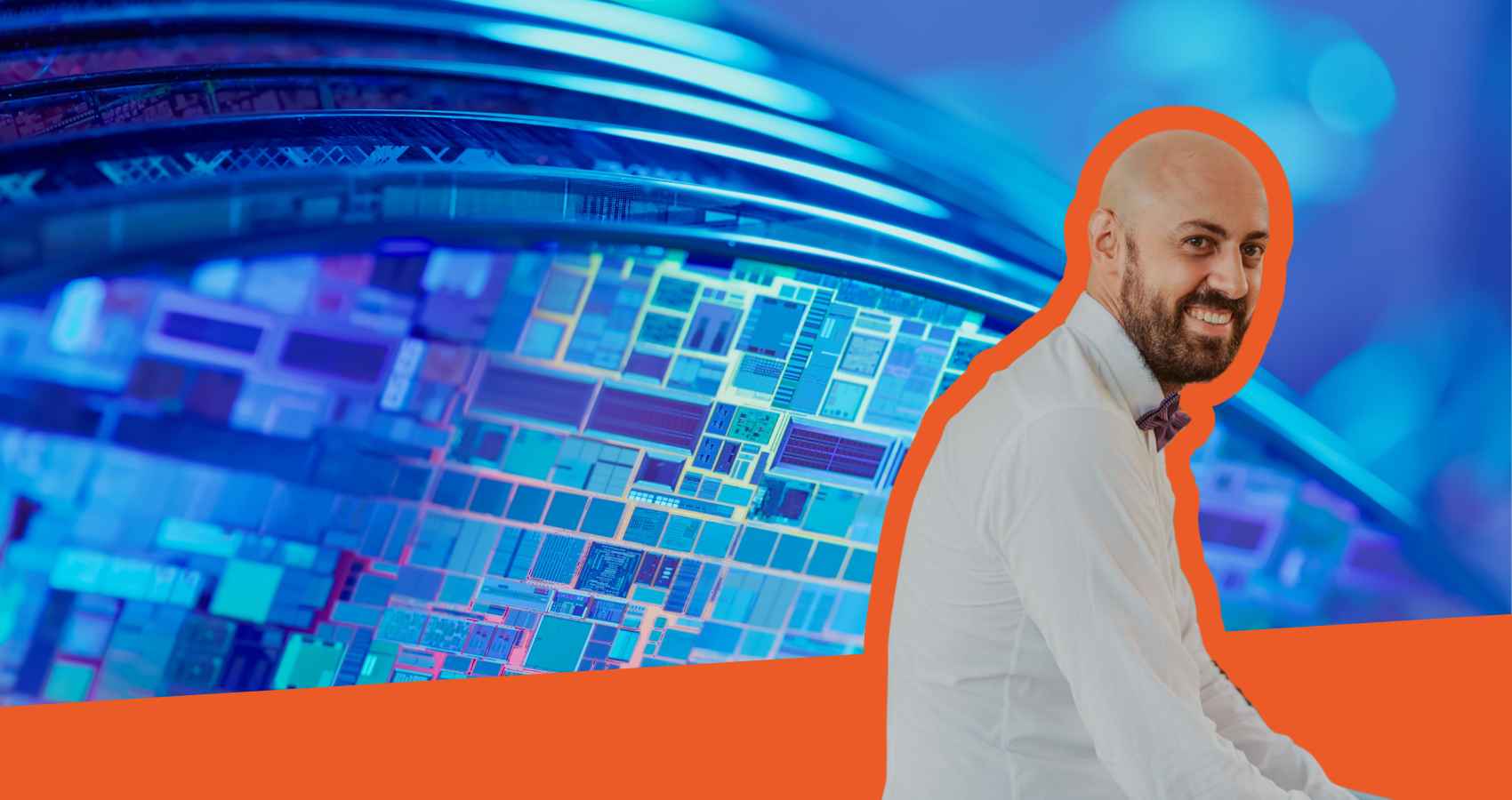
Career paths do not always follow a straight line. Sometimes they take shape through changes in direction, doubts, and new discoveries. This is also true for Federico, who today works in the semiconductor industry in the Netherlands as a Multidisciplinary Technical Lead, following a path built through diverse experiences, a passion for technology, and a constant desire to challenge himself.
At the beginning, his ideas about the future were not yet completely defined. “I started as an IT technician, then attended two years of Electronic Engineering in Milan before moving to Trento and pursuing Industrial Engineering, where I truly found my path,” he explains. The turning point came during his university years, thanks to subjects such as solid mechanics, design, and materials science. “Professors Bigoni, Molinari, and especially Professor Fontanari were a great source of inspiration. I loved every course related to materials and design.”
Before university, imagining a future in the semiconductor industry seemed almost impossible. “I would have never imagined ending up in the Netherlands, working in semiconductors and designing systems with micron- or even nanometer-level precision.” Today, his role goes far beyond technical coordination: “I do not just manage teams, but act as a bridge between mechanics, electronics, and software.”
His first concrete contact with the corporate world came through his thesis and internship at a design start-up in Rovereto, recommended by Professor Fontanari. “I immediately fell in love with the challenges that emerged every day. In that environment, I had the opportunity to create my first project: a special loading system for an electrically powered stair-climbing tracked conveyor. I have to say that structural simulation was one of the things that fascinated me from the very beginning.”
The company experience also proved fundamental in understanding workplace dynamics that university can only partially introduce. “The internship made me realize many things I had never considered before. There are companies working on incredible and highly challenging projects, realities that are often difficult to fully discover during university studies.”
He describes the transition from theory to practice as one of the most exciting moments of his journey. “We study in order to reach the day when we see our studies transformed into reality.” Working in a start-up allowed him to experiment, make mistakes, and concretely see his projects become functional prototypes. “I still remember staying at the office until late at night analyzing structural simulations, more out of passion than obligation.”
Today, he works as a Multidisciplinary Technical Lead at NTS Group, a company specialized in developing customized systems for the semiconductor industry. His role requires continuous integration between different disciplines. “My main task is to ensure that a decision made in software does not create a bottleneck in the hardware, and vice versa, optimizing the entire mechatronic ecosystem.”
The complexity of the industry makes every project an ongoing challenge. “In traditional mechanics, you work with tolerances in hundredths or thousandths of a millimeter; in semiconductors, you work with nanometers.” This means that every component of the system — mechanics, electronics, and software — must operate at the limits of its physical capabilities.
The greatest difficulties do not concern only technical aspects, but also the management of people and resources. “Over the years, I have learned that everyone is motivated by different things.” To face the most complex situations, he emphasizes the importance of passion and the ability to keep one’s goals clear. “Even in the most difficult moments, I have always tried to remember why I do this job.”
Looking ahead, the semiconductor industry is described as one of the most dynamic and innovative sectors in the world. According to Federico, technologies such as artificial intelligence and quantum computing will have an increasingly profound impact in the coming years. “What we can do as engineers is remain dynamic and take advantage of all the tools that new technologies will provide.”
Alongside technical skills, soft skills also emerge as crucial. “A solid technical background is essential, but it is never enough.” Throughout his career, he learned a great deal thanks to constant interaction with colleagues and more experienced professionals. “I was fortunate to meet people willing to put up with my endless ‘whys.’”
Teamwork is considered essential, especially in complex systems. “Innovation does not follow hierarchy. Every insight can be fundamental, whether it comes from a mechanical assembler or the CEO.” Communication also plays a central role: “Honesty and clarity are fundamental. Everyone must know their role and responsibilities, but it is equally important to keep the team engaged and motivated.”
Curiosity continues to be the main driving force behind his professional journey. “I thrive on challenges. Every new technical application is an opportunity to learn more deeply and find new solutions.” For this reason, he considers continuous learning an essential necessity, especially in a rapidly evolving sector.
To young people who want to pursue a similar path, he recommends patience and a willingness to challenge themselves. “A house is built brick by brick. As a recent graduate, it is important not to think you are entitled to important roles right away, because there is still a lot to learn. If you want a broader overview and are willing to work hard, start-ups or small companies are for you. If instead you want to specialize in very specific fields, try to join large companies: they have far more resources for in-depth development, but you need patience because the pace is completely different. That is what I would tell myself.”
The most important qualities, however, remain curiosity, the ability to confront one’s weaknesses, and the willingness to move wherever the market offers new opportunities. “I hope I never lose the curiosity and passion for what I do, because when that happens, my work will stop being enjoyable.”
Looking at the future of the industry, he already foresees new transformations on the horizon. “The semiconductor industry is approaching increasingly concrete physical limits. When it is no longer possible to further miniaturize, the industry will move from ‘More Moore’ to ‘Beyond Moore’: not making everything smaller, but making everything differently. And that is where new challenges will begin.”