Information magazine of the Department of Industrial Engineering
Università di Trento
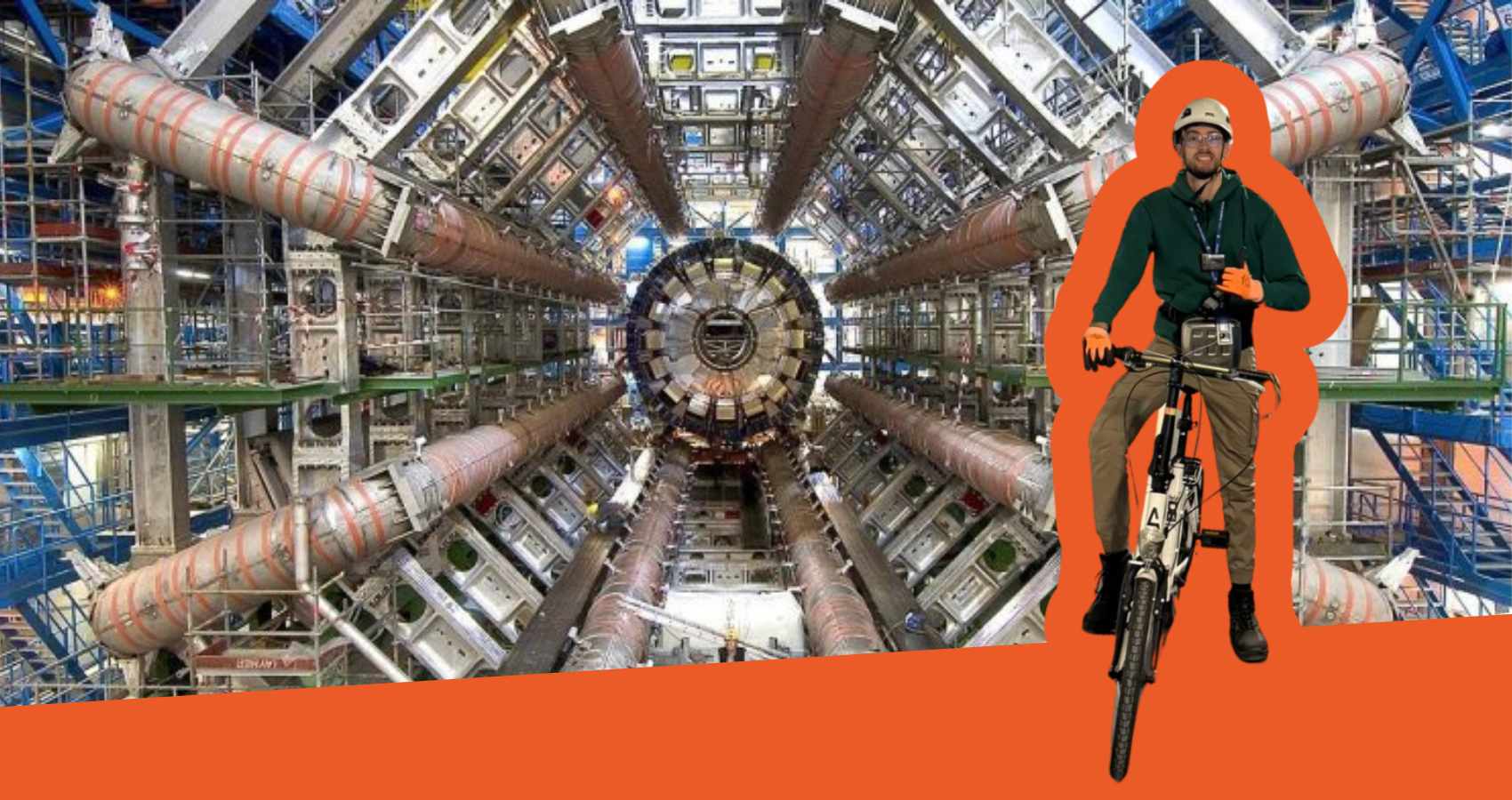
Entering CERN does not simply mean gaining access to one of the symbolic places of global scientific research. It means being part of an environment where design, experimentation, and collaboration coexist every day, where robotic, mechanical, electronic, and computer engineers work side by side to tackle problems that require innovative and case-specific solutions. It is a context in which technical creativity is not an accessory element, but a concrete resource that is recognized and valued.
It is precisely here that the journey of Francesco Baroni, a student from the University of Trento, has taken shape. Today, he is involved in a PhD project at CERN in collaboration with UniTrento. His story represents much more than personal growth: it shows how an international and multidisciplinary environment can become a true learning space, where the knowledge acquired at university turns into tools for designing, building, and contributing to cutting-edge technologies.
Francesco’s first encounter with CERN came during his Bachelor’s degree in Industrial Engineering, thanks to the support of Professor Matteo Saveriano. During those two months dedicated to his thesis, he found himself immersed in an advanced research environment, where ideas had to be tested quickly and where every technical solution emerged from continuous interaction among different areas of expertise.
During this experience, Francesco developed a mobility system capable of switching from conventional wheels to omnidirectional wheels and even to a tracked configuration, supporting the project with structural analyses and robotic motion simulations. This was not merely an academic exercise, but a concrete example of what makes CERN a unique place for a young engineer: the opportunity to work on real problems, using advanced tools and within an ecosystem where design and experimentation continuously feed one another.
This dimension perfectly reflects the role that robotics plays at CERN today. Robotic solutions are developed to operate in complex and challenging environments, supporting inspections, maintenance activities, and operations in areas where safety, reliability, and precision are essential. CERN highlights that these systems are intended to increase safety, improve facility availability, and enable interventions in hostile or hard-to-access environments.
For Francesco, this first experience left a clear impression: CERN is not merely a place where research is observed, but a place where one can actively contribute to building it.
After completing his Bachelor’s degree, Francesco continued his studies at the University of Trento with a Master’s degree in Mechatronics Engineering, while also working for an engineering consultancy company in Rovereto. Yet his connection with CERN remained strong. His thesis experience had left open the possibility of returning to an environment that he perceived not only as highly enriching from a technical perspective, but also extraordinarily stimulating on a human level.
After two years of balancing studies and work, a new opportunity emerged. Francesco applied for a position as a mechatronics engineer at CERN and was selected for a six-month contract, during which he contributed to the development of one of the laboratory’s robotic platforms. During this phase, he put into practice the skills acquired in Trento, including CAD design, finite element analysis, design validation, prototyping, and assembly.
One of the most valuable aspects of this experience was the opportunity to follow the entire development cycle of a system: from the initial idea to design, verification, and physical construction. In an environment such as CERN, engineering takes tangible form, and the laboratory becomes the place where theory is transformed into something real.
Alongside the technical dimension, the human aspect also stands out. CERN hosts many young researchers, students, thesis candidates, and early-career engineers from different universities and countries. This makes everyday work highly dynamic and international, but also deeply social. Professional collaboration is accompanied by a shared life made up of cultural exchanges, friendships, organized leisure activities, and experiences enjoyed together outside the laboratory.
For those arriving from abroad, living at CERN often means becoming part of a young and open community, where interactions extend far beyond working hours. The surroundings of Geneva become an integral part of the experience: excursions, trips, weekends between the lake and the mountains, and countless opportunities to meet people from very different backgrounds and cultures. This is another reason why CERN is such a formative place: not only because of what one learns while designing complex systems, but because of the environment in which one grows, surrounded by world-class research and international relationships that deeply enrich personal development.
Following the quality of his work, Francesco was offered a second contract, this time lasting one year. During this period, he worked on several projects, including topological optimization for robotic arms and computational fluid dynamics simulations for the cooling systems of electronic boards. He also had the opportunity to interact directly with mechanical and electronic component suppliers and became a technical reference for several projects within the robotics section.
This confirms that CERN is not only a prestigious destination, but also a genuine work and research opportunity for young engineers eager to challenge themselves in a competitive, practical, and at the same time deeply human environment.
Today, Francesco’s journey is looking even further ahead. He has obtained a PhD position that will involve him in the design and development of what will become the largest robotic system ever built at CERN: a rail-based system designed to move along the ceiling of the Future Circular Collider, CERN’s next major project aimed at exploring the physics of the future.
The infrastructure under consideration extends for approximately 90 kilometers, a scale that alone conveys the ambition of the project. The Future Circular Collider represents not only a new accelerator but also a long-term vision for European and international scientific research. Conceiving a machine of this magnitude means imagining today the tools, technologies, and systems that will make tomorrow’s scientific work possible.
It is within this scenario that Francesco’s work takes place. The robotic system at the center of his PhD research, equipped with eleven degrees of freedom, is being conceived as a multifunctional support system within the future accelerator. The project perfectly summarizes the kind of challenge that CERN can offer: not simply the application of existing technologies, but the creation of entirely new tools designed to meet needs that are still taking shape today.
Working on a project of this scale also means confronting one of the most fascinating dimensions of engineering research: the one in which the future is not observed from afar, but actively built. In this sense, Francesco’s journey perfectly combines education, research, and vision, bringing together the experience gained between UniTrento and CERN within one of the most ambitious projects of the coming years.
Today, Francesco’s ambition is to give back to the environment that has offered him so much. After finding at CERN a context capable of valuing skills, initiative, and collaboration, his mission is to ensure that this same opportunity becomes accessible and visible to many others.